
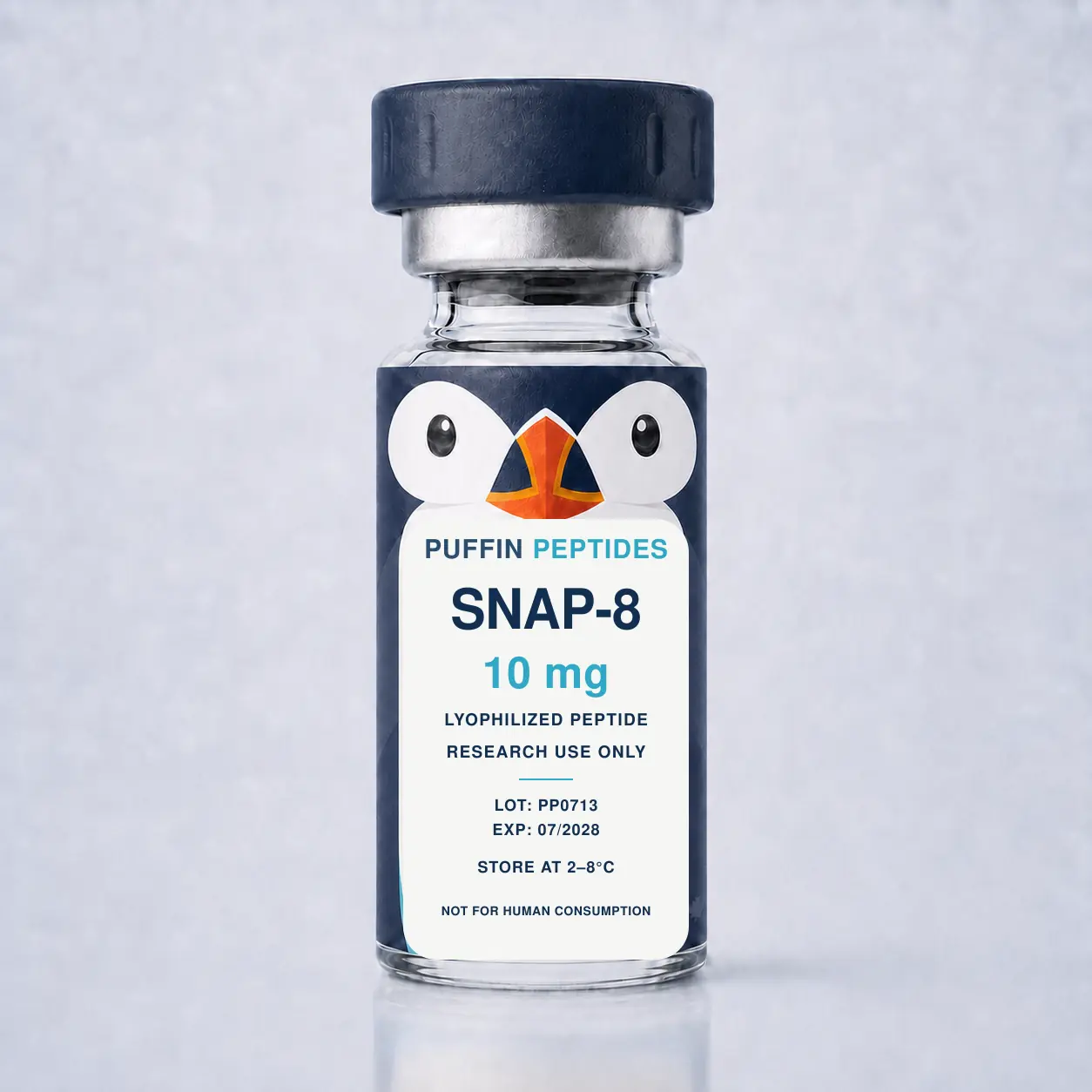
 Catalogue preview · final packaging and presentation may vary if stocked
Five choices across your ballotUse votes only for compounds you would consider ordering
One vote per compoundEach candidate can be selected once on this browser
Flexible interest signalRemove or reassign a vote whenever you like
SNAP-8
SNAP-8, usually acetyl octapeptide-3, is a cosmetic-research peptide designed from part of the SNAP-25 protein. It is studied for possible effects on SNARE-complex assembly and localized contraction-related appearance models.
Loading your saved choices…
SNAP-8 is currently being evaluated through customer voting and is not available to order. Final product specifications and batch documentation will be published only if it joins the catalogue.
This page records catalogue interest only. If SNAP-8 is selected for supply, Puffin will publish the confirmed format, batch documentation, and laboratory preparation information on the product listing.
Storage and handling requirements depend on the final supplied format. Confirmed instructions will be provided with the batch details if this candidate is added to the catalogue.
Understanding Snap-8
Explore the science, research focus, and key information behind this compound.
What is Snap-8?+
SNAP-8 is selected for focused in-vitro work on acetylated peptide structure and contraction-related signalling.
What Researchers Study+
Researchers examine SNARE-related signalling, Muscle-contraction models, and Cosmetic-peptide research.
How Snap-8 Works+
The proposed idea is that the short peptide competes with native SNAP-25 interactions needed for neurotransmitter-vesicle fusion. In plain language, it is a molecular mimic intended to soften a signalling step—not a topical form of botulinum toxin and not proven to block nerves.
Research at a Glance+
SNARE mimicry is plausible but not fully established in skin. The peptide was designed around a region of SNAP-25, but reaching the relevant intracellular machinery through a topical formulation is a separate delivery question. Formulation studies need independent confirmation. Small cosmetic studies can measure wrinkle appearance without proving the proposed intracellular mechanism. Vehicle, hydration, imaging, blinding, and sponsor independence matter. It is not “Botox in a peptide”. Botulinum toxin is a potent biological neurotoxin with a distinct mechanism, delivery route, and regulated evidence base. The comparison is marketing shorthand, not scientific equivalence.
If this candidate is added to the catalogue, it would be offered for controlled laboratory research only. It is not for human consumption and is not represented as a medicine, treatment, supplement, or substitute for an approved product.