
At a glance
- SNAP-8, usually acetyl octapeptide-3, is a cosmetic-research peptide designed from part of the SNAP-25 protein. It is studied for possible effects on SNARE-complex assembly and localized contraction-related appearance models.
- SNAP-8 is not an approved injectable medicine. Much of the available support comes from ingredient-supplier, in vitro, formulation, or small cosmetic studies, with limited robust independent human evidence.
- Test the exact acetyl octapeptide-3 sequence and formulation rather than the SNAP-8 trade shorthand alone.
- Use SNARE-related biochemical or cellular endpoints before interpreting skin-surface appearance measurements.
What SNAP-8 is—and what the name does not establish
SNAP-8, usually acetyl octapeptide-3, is a cosmetic-research peptide designed from part of the SNAP-25 protein. It is studied for possible effects on SNARE-complex assembly and localized contraction-related appearance models.
The proposed idea is that the short peptide competes with native SNAP-25 interactions needed for neurotransmitter-vesicle fusion. In plain language, it is a molecular mimic intended to soften a signalling step—not a topical form of botulinum toxin and not proven to block nerves.
Questions to settle before interpreting a result
A useful SNAP-8 study begins with material identity, a defined model, a relevant comparator, and an endpoint chosen before the result is known. Broad catalogue language cannot replace those controls.
- Test the exact acetyl octapeptide-3 sequence and formulation rather than the SNAP-8 trade shorthand alone.
- Use SNARE-related biochemical or cellular endpoints before interpreting skin-surface appearance measurements.
- Keep topical cosmetic exposure separate from injectable, neuromuscular, or botulinum-toxin comparisons.
How to read the SNAP-8 evidence
These evidence snapshots summarize the most important distinctions in the published record. They do not combine unlike models or turn an experimental signal into a human-use claim.
Mechanistic hypothesis
- Design
- SNARE mimicry is plausible but not fully established in skin
- Finding
- The peptide was designed around a region of SNAP-25, but reaching the relevant intracellular machinery through a topical formulation is a separate delivery question.
- Read with care
- This is an interpretation boundary, not a claim that a specific outcome has been established in people.
Human evidence · limited
- Design
- Formulation studies need independent confirmation
- Finding
- Small cosmetic studies can measure wrinkle appearance without proving the proposed intracellular mechanism. Vehicle, hydration, imaging, blinding, and sponsor independence matter.
- Read with care
- This is an interpretation boundary, not a claim that a specific outcome has been established in people.
What not to claim
- Design
- It is not “Botox in a peptide”
- Finding
- Botulinum toxin is a potent biological neurotoxin with a distinct mechanism, delivery route, and regulated evidence base. The comparison is marketing shorthand, not scientific equivalence.
- Read with care
- This is an interpretation boundary, not a claim that a specific outcome has been established in people.
What the evidence does not establish
SNAP-8 is not an approved injectable medicine. Much of the available support comes from ingredient-supplier, in vitro, formulation, or small cosmetic studies, with limited robust independent human evidence.
Mechanism, cell, animal, observational, and controlled human evidence answer different questions. A positive result at one level cannot be silently promoted to another, and evidence for a sponsor’s defined product does not establish equivalence for an independently sourced research material.
Keep the publication and the vial separate
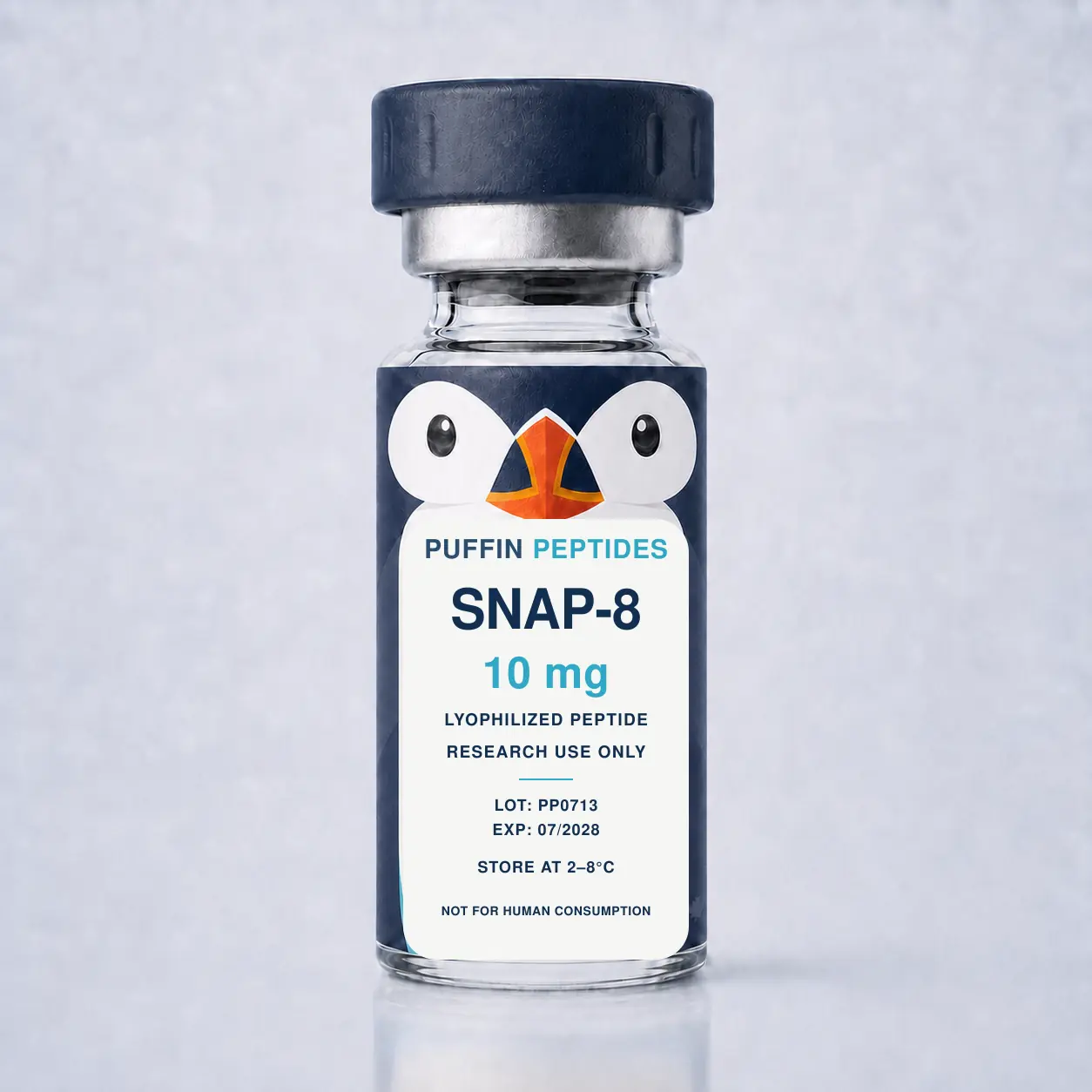
A published paper identifies its own sequence or chemical identity, formulation, manufacturing context, analytical controls, exposure, and test system. Matching a familiar name on a label is not enough to show that a catalogue vial is the same study material.
For practical research planning, verify the lot-specific identity and documentation, then write the model, comparator, endpoint, and stopping criteria before testing. This guide does not provide preparation, dosing, injection, or human-use instructions.
Sources
Links lead to the paper, official registry, regulator page, or product label used for this guide. Registry records describe protocols and status; they are not treated as positive results.
- Method development for acetyl octapeptide-3 analysis by liquid chromatography–tandem mass spectrometryJournal of Analytical Science and Technology · 2020
Primary analytical-method paper for acetyl octapeptide-3. It supports identity and quantification work; it does not by itself establish skin penetration, mechanism, or clinical wrinkle outcomes.
- Think twice before injecting peptides bought online: unauthorized products can seriously harm youHealth Canada · 2026
Official Canadian advisory explaining that a research-use label does not establish authorization, safety, efficacy, or product quality for human use.
Vote for SNAP-8
This compound is not currently stocked. Add it to your five-choice catalogue ballot.