
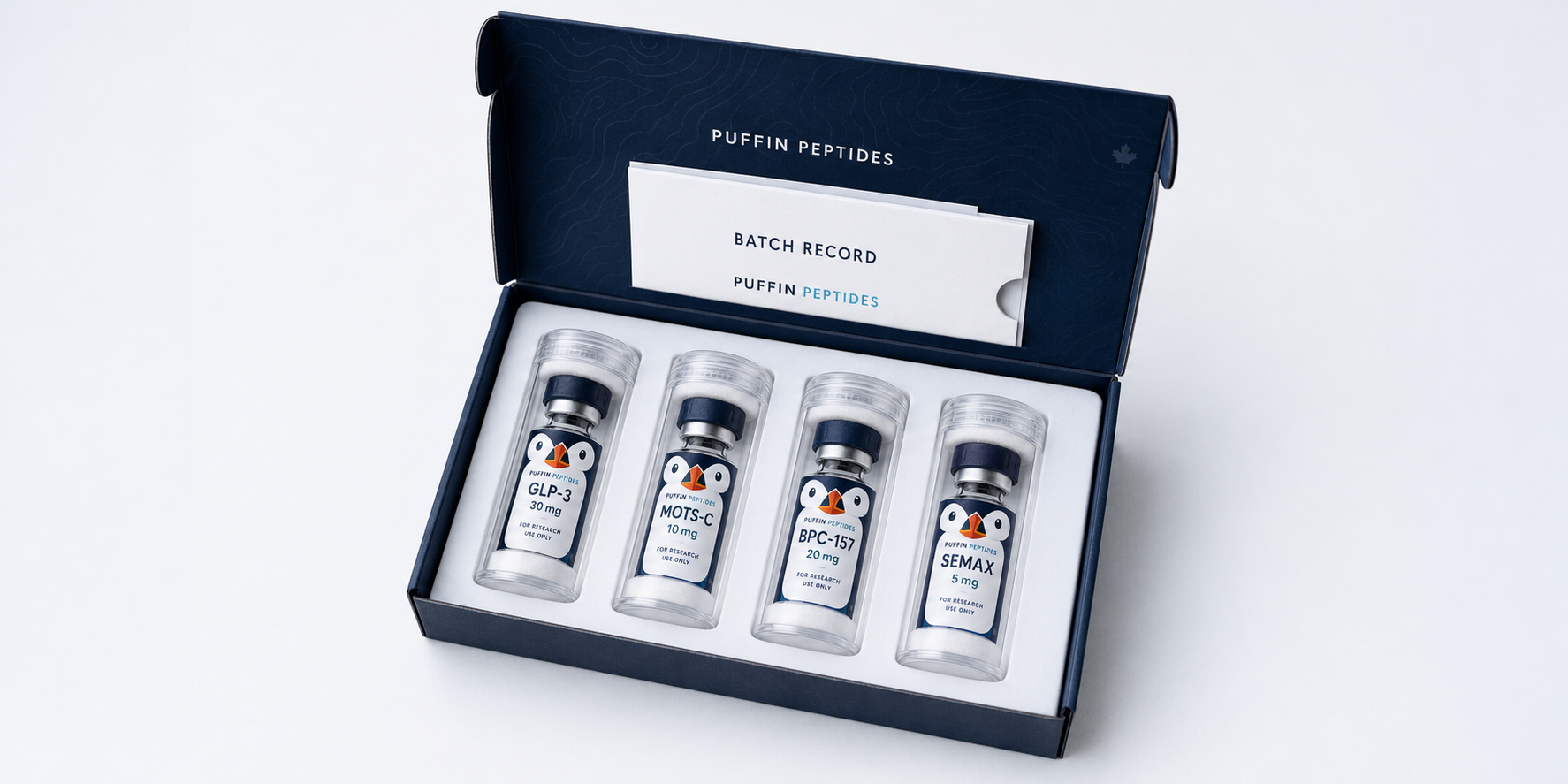
At a glance
- A peptide is a chain of amino acids, but the word “peptide” alone does not tell you what a molecule does.
- Sequence, chemical modifications, physical format, and batch quality all affect how a research material should be identified.
- Cell, animal, and human studies answer different questions; evidence does not automatically transfer from one level to the next.
- Identity, chromatographic purity, content, sterility, and endotoxin are separate quality attributes.
- A research-use label is a boundary: it does not make a material an approved medicine or suitable for human consumption.
What is a peptide?
A peptide is a molecule made from amino acids joined by peptide bonds. Amino acids are the same broad class of building blocks used to make proteins. The dividing line between a peptide, a polypeptide, and a small protein is not one universally fixed number, so context matters more than memorizing a cutoff.
Order matters. A chain made from the same amino acids in a different sequence is a different molecule, just as the same letters arranged differently create a different word. Sequence influences shape, charge, stability, receptor binding, and how enzymes may break the chain down.
Some research peptides copy a naturally occurring sequence. Others are analogues: researchers alter one or more amino acids or add a chemical feature to study stability, selectivity, solubility, or duration of exposure. Terms such as acylated, amidated, pegylated, or conjugated describe modifications; they should not be treated as decorative parts of a name.
How peptides can produce a biological signal
Many peptides act by binding to receptors on or inside cells. An agonist activates a receptor response; an antagonist reduces or blocks activation. Other peptides may act as enzyme substrates or inhibitors, bind another molecule, or serve as a signalling fragment. The mechanism has to be demonstrated for the particular molecule and model—it cannot be inferred from the word “peptide.”
Selectivity is rarely a simple on-or-off property. Apparent potency can change with receptor expression, cell type, assay design, incubation time, and signal amplification. A result from one engineered cell line may not reproduce in tissue or a whole organism.
Milligrams measure mass, not biological potency. Five milligrams of one compound cannot be ranked against five milligrams of another without molecular-weight, concentration, receptor, and assay context. Even two analogues aimed at the same receptor may have different potency, efficacy, stability, and exposure profiles.
How to read the evidence ladder
Evidence levels are not a scoreboard where one positive experiment proves the next. Each level answers a narrower question and introduces different sources of uncertainty.
In vitro · cells, receptors, or biochemical systems
- Design
- Researchers control concentration and conditions closely to examine binding, signalling, enzyme activity, toxicity, or another defined mechanism.
- Finding
- A well-designed experiment can show that a molecule is active in that assay and help estimate potency, selectivity, or mechanism.
- Read with care
- It does not establish absorption, distribution, metabolism, whole-organism safety, or a useful outcome in humans.
In vivo · animal models
- Design
- A molecule is studied in a living organism, often using a disease, injury, or physiology model chosen to answer a specific question.
- Finding
- Animal work can connect exposure with tissue effects, pharmacokinetics, toxicology, and functional outcomes under controlled conditions.
- Read with care
- Species biology, model construction, route, exposure, and endpoints may not translate to people. An animal result is not human efficacy.
Phase 1 · initial human investigation
- Design
- Early trials generally focus on safety, tolerability, pharmacokinetics, and dose or exposure behaviour in a defined group.
- Finding
- They can identify common short-term signals and show how the investigational product behaves under the study protocol.
- Read with care
- Small numbers and short follow-up usually cannot establish broad efficacy, uncommon harms, or long-term outcomes.
Phase 2, Phase 3, and post-approval evidence
- Design
- Later trials test prespecified outcomes in larger groups; phase 3 typically provides confirmatory evidence. Phase 4 and post-market systems study an authorized product in wider use.
- Finding
- Randomization, comparators, prespecified endpoints, and larger samples can provide increasingly reliable estimates for the exact intervention and population studied.
- Read with care
- A registry entry is a protocol record, not a result. Approval applies to a specific product, formulation, indication, and regulator—not every material sharing a compound name.
How to read a peptide research product page
Start by separating the compound from the variant. The compound name identifies the research subject; the variant identifies a particular presentation, such as a stated mass, concentration, blend, or vial format. A sale applying to a compound does not necessarily describe every variant, and a strength label does not establish measured content on its own.
Next, identify the physical format. Lyophilized means the material has been freeze-dried into a solid presentation. A prepared solution is already liquid. A diluent is a separate laboratory material and is not the active peptide. These formats have different handling questions and should never be collapsed into one generic assumption.
Finally, look for a batch or lot identifier. Product-level information describes the catalogue item; batch-level documentation describes a specific production lot. If documentation cannot be connected to the exact lot, it cannot confirm that lot’s test result.
- Compound: the molecule or defined combination being studied.
- Variant or strength: the labelled presentation for a particular catalogue option.
- Format: lyophilized powder, prepared solution, blend, or laboratory diluent.
- Lot or batch: the production group to which batch-specific records apply.
- Stock status: commercial availability, not evidence quality.
- Research-use statement: the permitted-use boundary, not a clinical recommendation.
What a certificate of analysis can—and cannot—show
A certificate of analysis, or COA, summarizes tests for a specific material or batch. Its value depends on the sample tested, methods used, method suitability, acceptance criteria, laboratory, and whether the document can be matched to the product lot. A polished PDF alone is not verification.
Identity asks whether the expected molecule is present. Purity estimates how much of the detected material is the target relative to specified or detected related substances under a particular method. Assay or content estimates how much target material is present. These are different questions.
This distinction explains a common misunderstanding: “99% purity” does not necessarily mean 99% of everything in the vial is active peptide, nor does it prove the labelled mass. Chromatographic purity is usually a relative result within the method’s detected peaks. Water, counterions, excipients, non-detected material, and total content require appropriate measurements of their own.
Sterility, microbial limits, bacterial endotoxin, residual solvents, water content, aggregation, and stability are also separate attributes. One HPLC result cannot establish all of them. Which tests are relevant depends on the material, format, research purpose, and applicable quality system.
Ten terms worth knowing
Peptide literature becomes easier to read once a small set of recurring terms is clear. Definitions below are deliberately practical rather than exhaustive.
- Analogue: a molecule related to another sequence but intentionally modified.
- Agonist: a ligand that activates a receptor response.
- Antagonist: a ligand that blocks or reduces receptor activation.
- Affinity: how strongly a molecule binds under defined conditions; it is not the same as functional potency.
- Potency: the amount or concentration associated with a defined effect in a particular assay.
- Efficacy: the maximum response a molecule can produce in a defined system.
- Pharmacokinetics: what an organism does to a substance over time—often summarized as absorption, distribution, metabolism, and elimination.
- Pharmacodynamics: what the substance does to the biological system, including the relationship between exposure and effect.
- In vitro / in vivo: outside a living organism in a controlled system / within a living organism.
- Endpoint: the prespecified measurement used to answer a study question.
A better way to begin a research project
Begin with the question, not the catalogue. Define the mechanism or outcome you want to test, select a model that can answer it, and decide the primary endpoint before examining results. A product should fit the protocol; the protocol should not be invented to justify a product.
Controls make interpretation possible. Depending on the experiment, that may include a vehicle control, a reference ligand, a positive control, a receptor-specific control, or an inactive sequence. Replication, blinding, randomization, and predefined exclusion rules reduce avoidable bias.
Document the material as carefully as the biology. Record the exact compound, variant, lot, source, storage history, preparation under the laboratory protocol, analytical evidence, and deviations. Follow institutional biosafety, ethics, waste-handling, and legal requirements that apply to the model and jurisdiction.
- Write one answerable question and one primary endpoint.
- Choose a model and controls that distinguish the proposed mechanism.
- Verify material identity and batch documentation before the experiment.
- Predefine replicates, analysis, exclusions, and stopping criteria.
- Record lot-level traceability and every protocol deviation.
Research material is not a medicine
Clinical studies and approved medicines use controlled formulations manufactured and released within specific regulatory systems. A separately sourced research material is not authenticated by a paper about the same named compound. It may differ in identity, content, impurities, excipients, sterility, stability, and container closure.
Health Canada warns that unauthorized injectable peptide products sold online have not been assessed for safety, efficacy, quality, or appropriate labelling and may pose serious risks. A “research use only” label should never be interpreted as a workaround for self-experimentation or human use.
Sources
Links lead to the paper, official registry, regulator page, or product label used for this guide. Registry records describe protocols and status; they are not treated as positive results.
- Definition of peptideU.S. National Cancer Institute · Current dictionary
Plain-language definition of peptides as amino-acid chains.
- Learn About StudiesClinicalTrials.gov · Updated 2026
Official explanation of clinical-study types, phases, and study design.
- How to Read a Study RecordClinicalTrials.gov · Updated 2026
Official guide to interpreting registry fields and status information.
- Q6A Specifications: Test Procedures and Acceptance CriteriaU.S. Food and Drug Administration · Current guidance
Authoritative distinction among identity, assay, impurities, and other specifications.
- Analytical Procedures and Methods Validation for Drugs and BiologicsU.S. Food and Drug Administration · 2015
Guidance on methods supporting identity, strength, quality, purity, and potency.
- Think twice before injecting peptides bought onlineHealth Canada · 2026
Official warning about unauthorized injectable peptide products and human-use risks.