
At a glance
- CagriSema is the coadministration of cagrilintide and semaglutide—not a single dual-agonist peptide.
- Cagrilintide is a long-acting amylin analogue; semaglutide is a GLP-1 receptor agonist.
- Large phase 3a trials report changes in body weight and metabolic outcomes over 68 weeks.
- Trial outcomes do not prove that a separately sourced research material is identical to the formulation used in a clinical study.
What CagriSema actually is
CagriSema is a development name for the coadministration of two separate molecules: cagrilintide and semaglutide. That wording matters. It is not one peptide engineered to activate both amylin and GLP-1 receptors. Each component has its own structure, receptor pharmacology, exposure profile, and analytical identity.
Cagrilintide is a long-acting, acylated analogue of amylin. Amylin is a pancreatic peptide hormone released alongside insulin and involved in post-meal signalling, gastric emptying, and satiety-related pathways. Semaglutide is a long-acting GLP-1 receptor agonist. GLP-1 receptor signalling is studied in relation to glucose-dependent insulin secretion, glucagon regulation, gastric emptying, and appetite-related neural circuits.
Researchers pair the two pathways because they overlap in some physiological outcomes while acting through different receptors. The scientific question is not simply whether two appetite-related signals are stronger than one. It is whether their effects are additive, complementary, or limited by tolerability and exposure when studied together.
The mechanistic rationale
Amylin receptors are complexes formed from the calcitonin receptor and receptor-activity-modifying proteins. GLP-1 receptors belong to a different receptor family. Studying both systems together lets investigators examine parallel signalling that converges on food intake, meal handling, and energy-balance behaviour without treating the pathways as interchangeable.
A combined study also introduces variables that a single-agent experiment does not. Investigators must account for the ratio between components, the timing of exposure, receptor engagement, desensitization, gastrointestinal effects, and whether a measured outcome can be attributed to one component or their interaction.
What the REDEFINE trials found
The most informative published evidence comes from two 68-week, randomized phase 3a trials. Percentages below are trial-level results, not promises about an individual outcome.
REDEFINE 1 · adults without type 2 diabetes
- Design
- 3,417 adults with overweight or obesity were assigned to CagriSema, cagrilintide, semaglutide, or placebo alongside lifestyle intervention.
- Finding
- Using the trial-product estimand, mean body-weight change at week 68 was −22.7% with CagriSema and −2.3% with placebo. The treatment-policy estimate was −20.4% versus −3.0%.
- Read with care
- Flexible dose escalation was used, and 57.3% of participants assigned to CagriSema were receiving the highest dose at week 68. The estimand and dose distribution are essential context.
REDEFINE 2 · adults with type 2 diabetes
- Design
- 1,206 adults with overweight or obesity and type 2 diabetes were randomized to CagriSema or placebo for 68 weeks.
- Finding
- The treatment-policy estimate for mean body-weight change was −13.7% with CagriSema and −3.4% with placebo. A glycated haemoglobin level of 6.5% or lower was reported in 73.5% versus 15.9%.
- Read with care
- This population, background care, and endpoint framework differ from REDEFINE 1, so the two percentages should not be treated as directly interchangeable.
Tolerability signal
- Design
- Both trials prospectively recorded adverse events while doses were escalated flexibly.
- Finding
- Gastrointestinal events were the most common adverse events and were generally described as transient and mild to moderate.
- Read with care
- Frequent mild or moderate events still influence adherence, achieved dose, missing data, and how an efficacy estimate should be read.
How to read the percentages responsibly
Clinical trial reports can present more than one estimand because they answer different questions. A trial-product estimand asks what happened under a framework closer to continued assigned treatment. A treatment-policy estimand incorporates outcomes regardless of treatment discontinuation or use of other interventions. Neither is inherently the “real” number; each describes a different analytical question.
Flexible dosing also deserves attention. A headline may name a target dose while many participants finish at a lower tolerated dose. In REDEFINE 1, the achieved-dose distribution is part of the result, not a footnote to discard. It helps explain how efficacy and tolerability interacted in practice.
Finally, average change does not describe every participant. Response distributions, discontinuations, missing-data assumptions, eligibility criteria, and trial support all affect external validity. A controlled 68-week trial cannot answer every question about longer exposure or broader populations.
Useful laboratory research questions
For analytical work, the first task is to verify the identity and amount of each component independently. A combined label is not enough to establish molar ratio, purity, degradation products, aggregation, or biological activity. Orthogonal methods are especially useful because a single assay may not distinguish closely related impurities or quantify both components equally well.
Mechanistic experiments can then ask whether the components preserve expected receptor selectivity, whether one alters the apparent potency of the other, and how simultaneous versus staggered exposure changes a model. Those questions are more informative than assuming a clinical endpoint explains the underlying interaction.
- Confirm component identity and concentration with fit-for-purpose analytical methods.
- Track stability and degradation for each peptide rather than reporting only total peptide content.
- Use receptor-specific controls to separate amylin-receptor and GLP-1-receptor effects.
- Predefine whether the experiment tests additivity, synergy, or simple co-exposure.
What the evidence does not establish
The REDEFINE trials studied a controlled clinical formulation in defined populations. They do not establish that an independently sold research vial has the same identity, purity, potency, sterility, excipients, stability, or pharmacokinetics as the trial material.
The trials also do not convert laboratory material into an approved medicine or provide instructions for human use. Product quality must be assessed from batch-specific documentation and appropriate laboratory testing, not inferred from the name of a compound or a published clinical result.
Sources
Links lead to the paper, official registry, regulator page, or product label used for this guide. Registry records describe protocols and status; they are not treated as positive results.
- Coadministered Cagrilintide and Semaglutide in Adults with Overweight or ObesityThe New England Journal of Medicine · 2025
Peer-reviewed REDEFINE 1 phase 3a trial.
- Cagrilintide–Semaglutide in Adults with Overweight or Obesity and Type 2 DiabetesThe New England Journal of Medicine · 2025
Peer-reviewed REDEFINE 2 phase 3a trial.
- Research Study to See How Well CagriSema Works in People With Excess Body WeightClinicalTrials.gov · NCT05567796 · Current record
Official registry record for REDEFINE 1.
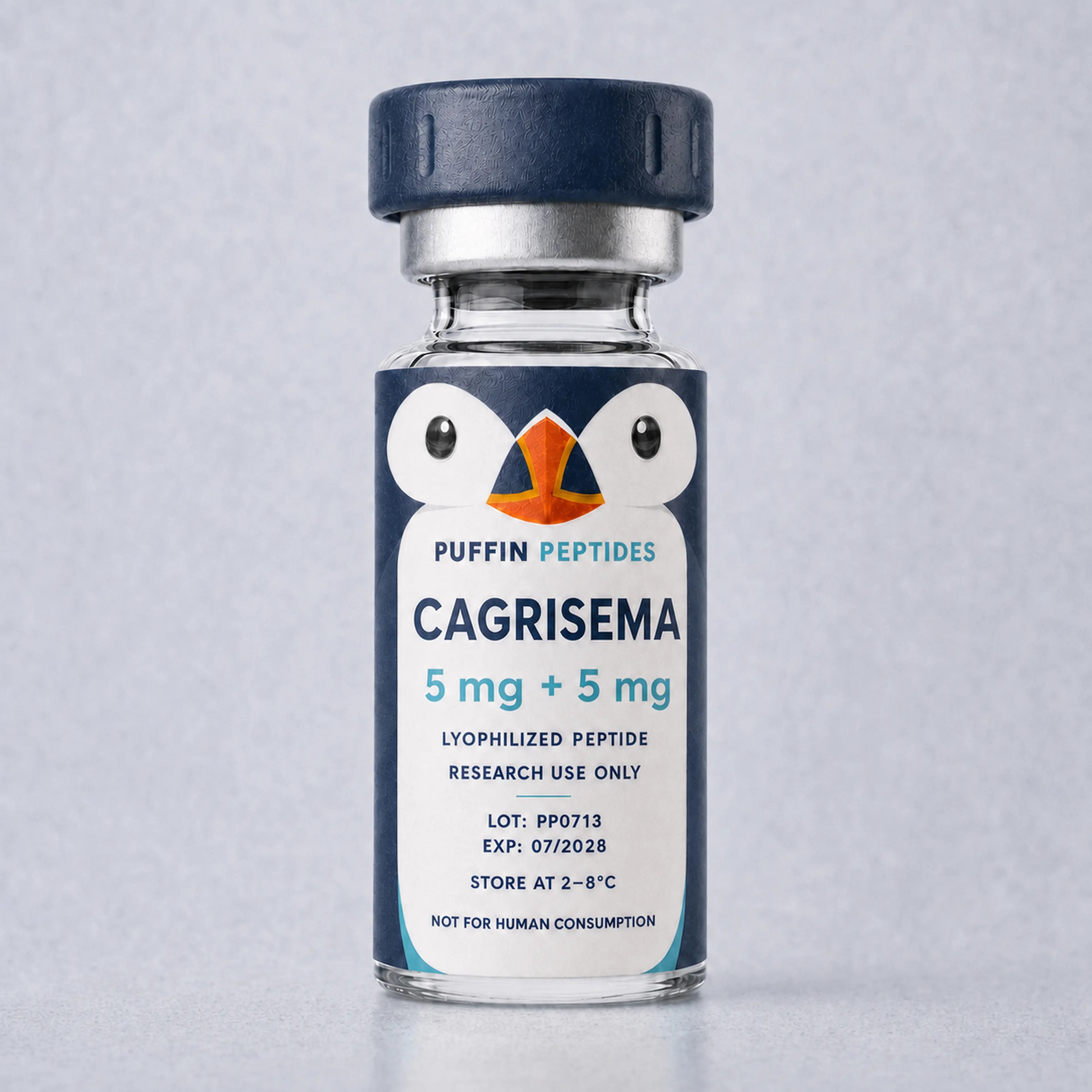
Explore CAGRISEMA
Review available strengths, pricing, stock status, and product documentation.