
At a glance
- HGH Fragment 176–191 is the C-terminal 16-amino-acid segment of human growth hormone. It is studied in lipid-metabolism models and should be kept distinct from full-length HGH and from the modified fragment AOD-9604.
- HGH 176–191 is not an approved medicine and does not have established human fat-loss or body-composition efficacy. Findings for full-length somatropin or modified AOD-9604 cannot automatically be applied to the unmodified fragment.
- Compare the unmodified fragment with AOD-9604 and full-length HGH under matched molar conditions.
- Measure lipolysis or lipid-storage endpoints separately from GH-receptor and IGF-1 signalling.
What FRAG HGH 176-191 is—and what the name does not establish
HGH Fragment 176–191 is the C-terminal 16-amino-acid segment of human growth hormone. It is studied in lipid-metabolism models and should be kept distinct from full-length HGH and from the modified fragment AOD-9604.
Preclinical research proposed that the C-terminal region contributes to some lipid-related effects of growth hormone without recreating the full growth-promoting signal. In plain language, the fragment is a tool for asking whether one small region carries a separable metabolic function.
Questions to settle before interpreting a result
A useful FRAG HGH 176-191 study begins with material identity, a defined model, a relevant comparator, and an endpoint chosen before the result is known. Broad catalogue language cannot replace those controls.
- Compare the unmodified fragment with AOD-9604 and full-length HGH under matched molar conditions.
- Measure lipolysis or lipid-storage endpoints separately from GH-receptor and IGF-1 signalling.
- Confirm terminal chemistry and sequence because a single modification changes the identity from Frag 176–191 to another analogue.
How to read the FRAG HGH 176-191 evidence
These evidence snapshots summarize the most important distinctions in the published record. They do not combine unlike models or turn an experimental signal into a human-use claim.
Preclinical rationale
- Design
- A C-terminal lipid-related region was proposed
- Finding
- Cell and animal work generated the hypothesis that GH’s C terminus has separable metabolic activity. The evidence does not establish a clinically useful or safe fragment therapy.
- Read with care
- This is an interpretation boundary, not a claim that a specific outcome has been established in people.
Identity distinction
- Design
- Frag 176–191 is not AOD-9604
- Finding
- AOD-9604 is a modified analogue based on the region; the unmodified fragment is a different material. Development and assay results should stay attached to the exact sequence.
- Read with care
- This is an interpretation boundary, not a claim that a specific outcome has been established in people.
What not to assume
- Design
- A fragment does not inherit full HGH effects
- Finding
- It should not be marketed with somatropin’s clinical deficiency evidence, growth effects, dosing, or safety profile.
- Read with care
- This is an interpretation boundary, not a claim that a specific outcome has been established in people.
What the evidence does not establish
HGH 176–191 is not an approved medicine and does not have established human fat-loss or body-composition efficacy. Findings for full-length somatropin or modified AOD-9604 cannot automatically be applied to the unmodified fragment.
Mechanism, cell, animal, observational, and controlled human evidence answer different questions. A positive result at one level cannot be silently promoted to another, and evidence for a sponsor’s defined product does not establish equivalence for an independently sourced research material.
Keep the publication and the vial separate
A published paper identifies its own sequence or chemical identity, formulation, manufacturing context, analytical controls, exposure, and test system. Matching a familiar name on a label is not enough to show that a catalogue vial is the same study material.
For practical research planning, verify the lot-specific identity and documentation, then write the model, comparator, endpoint, and stopping criteria before testing. This guide does not provide preparation, dosing, injection, or human-use instructions.
Sources
Links lead to the paper, official registry, regulator page, or product label used for this guide. Registry records describe protocols and status; they are not treated as positive results.
- Antilipogenic action of synthetic human-growth-hormone C-terminal sequence 177–191PubMed-indexed preclinical study · 1993
Primary preclinical work on a C-terminal fragment. It does not establish a safe or effective human therapy and should not be conflated with the modified AOD9604 sequence.
- Think twice before injecting peptides bought online: unauthorized products can seriously harm youHealth Canada · 2026
Official Canadian advisory explaining that a research-use label does not establish authorization, safety, efficacy, or product quality for human use.
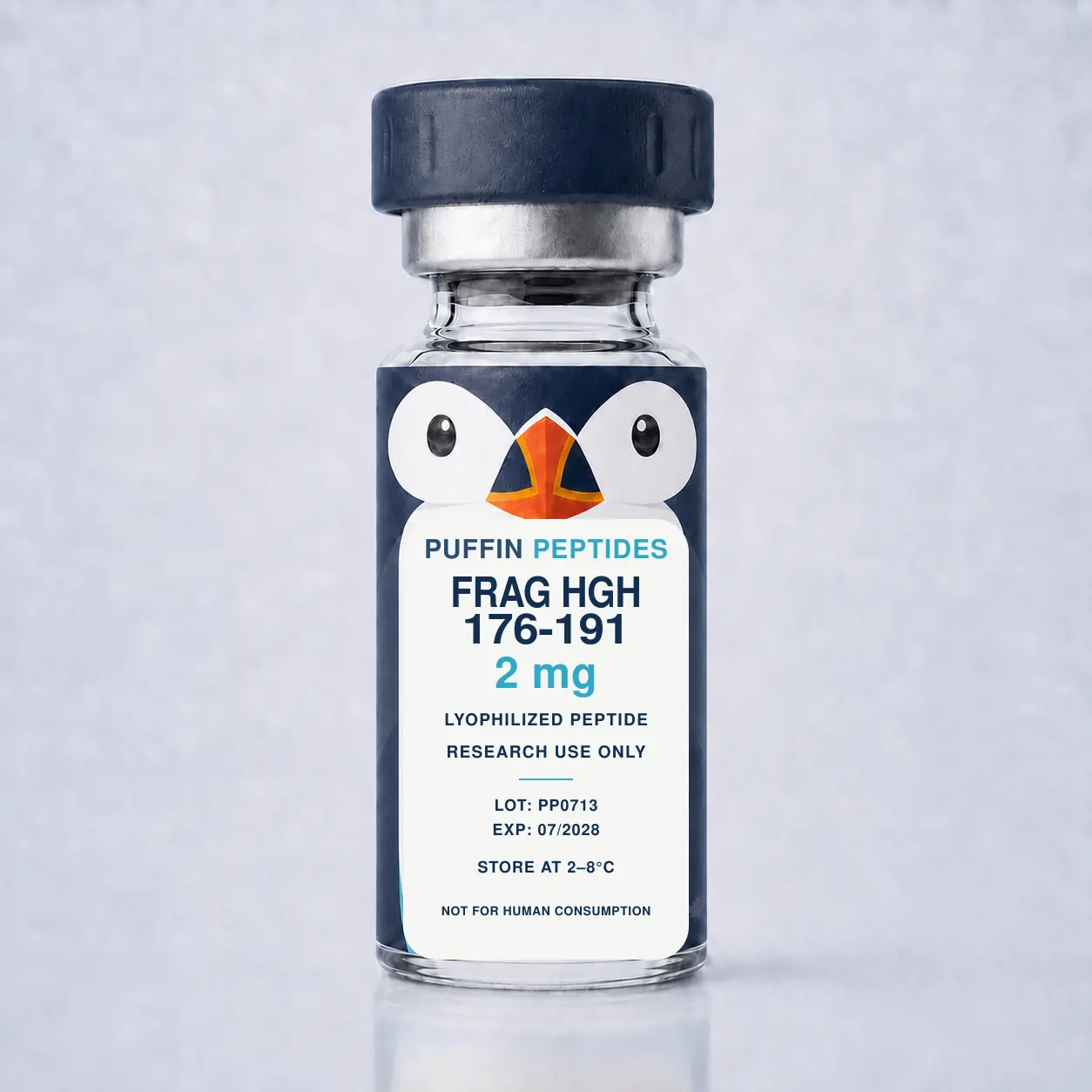
Vote for FRAG HGH 176-191
This compound is not currently stocked. Add it to your five-choice catalogue ballot.