
At a glance
- Retatrutide is one engineered peptide with agonist activity at GIP, GLP-1, and glucagon receptors.
- Its phase 2 obesity trial followed 338 adults for 48 weeks and showed dose-dependent mean weight change.
- A liver-fat analysis came from a much smaller MRI substudy and should not be generalized to the full trial.
- Published phase 2 results are evidence for further study, not proof of long-term benefit, regulatory approval, or equivalence of research material.
One molecule, three receptor targets
Retatrutide is a single engineered peptide designed to activate the glucose-dependent insulinotropic polypeptide receptor (GIPR), glucagon-like peptide-1 receptor (GLP-1R), and glucagon receptor (GCGR). “Triple agonist” refers to this receptor pharmacology. It does not mean the material contains three separate peptides.
The three receptors have overlapping and sometimes counterbalancing roles in nutrient handling and energy balance. GIP and GLP-1 are incretin pathways studied for glucose-dependent insulin secretion and metabolic signalling. Glucagon-receptor activity is associated with hepatic substrate handling and energy expenditure, while also creating questions about glucose regulation. The design challenge is therefore balance, not maximum stimulation of every receptor.
A triple-receptor profile must be measured rather than assumed. Potency, efficacy, receptor selectivity, cell background, assay amplification, and exposure can all change the apparent balance. Describing a molecule as active at three receptors is only the start of its pharmacological characterization.
Why researchers study the combination
Multi-receptor agonism is intended to coordinate signals that would otherwise be studied separately. In preclinical models, investigators can compare the parent molecule with receptor-selective controls, altered analogues, or combinations of single-receptor ligands. Those comparisons help test which receptor contributes to a measured effect.
Human trials answer a different question: what happens to prespecified clinical endpoints under a particular dosing and follow-up protocol. They do not by themselves reveal the contribution of each receptor. Mechanistic attribution requires complementary receptor pharmacology and translational experiments.
What the published phase 2 evidence shows
The figures that made retatrutide prominent come mainly from a 48-week obesity trial, supported by a separate type 2 diabetes trial and an exploratory liver-fat substudy.
Phase 2 obesity trial
- Design
- 338 adults with obesity, or overweight plus a related condition, and without type 2 diabetes were randomized across retatrutide dose groups or placebo for 48 weeks.
- Finding
- At week 48, mean body-weight change was −24.2% in the 12 mg group and −2.1% with placebo; the 8 mg group reported −22.8%. Changes were dose dependent.
- Read with care
- The curve had not clearly plateaued by week 48, which means the trial did not establish a final long-term magnitude or durability of effect.
Phase 2 type 2 diabetes trial
- Design
- 281 adults with type 2 diabetes were assigned to several retatrutide regimens, dulaglutide, or placebo for 36 weeks.
- Finding
- The study reported dose-dependent changes in glycated haemoglobin and body weight, supporting continued investigation in a population with diabetes.
- Read with care
- The population, comparator, duration, titration schedules, and endpoints differ from the obesity trial. Results should not be blended into one headline percentage.
Liver-fat substudy
- Design
- A subset of participants from the obesity trial underwent MRI-based liver-fat measurement.
- Finding
- At week 24, estimated relative liver-fat reductions ranged from −42.9% at 1 mg to more than −80% in the 8 mg and 12 mg groups, versus +0.3% with placebo.
- Read with care
- This was a small exploratory subgroup, with roughly 19 to 22 participants per dose group at baseline and fewer observations later. It is not equivalent to a dedicated liver-outcomes trial.
Tolerability and heart rate
- Design
- The obesity study tracked adverse events and vital signs across dose and escalation groups.
- Finding
- Gastrointestinal events were most common, were dose related, and were generally mild to moderate. Mean heart rate increased in a dose-dependent pattern, peaked around week 24, and later declined.
- Read with care
- A declining group mean does not resolve individual risk or long-term cardiovascular safety. Larger and longer outcome studies are needed.
Why phase 2 results need context
Phase 2 trials are designed to estimate activity, explore dose and escalation strategies, and identify signals that justify larger studies. They are not usually sized or followed long enough to settle uncommon safety events, long-term durability, or clinical outcomes such as cardiovascular events.
Dose escalation is part of the intervention. Faster starting schedules in the retatrutide programme were associated with more gastrointestinal effects, which illustrates why the nominal maintenance dose is not the whole protocol. Exposure history and tolerability can influence retention and the final estimate.
Subgroup analyses should also be read according to their sample size and purpose. The MRI liver-fat data are scientifically interesting because they generate a testable hepatic hypothesis. They should not be treated as confirmation of reduced fibrosis, fewer liver-related events, or benefit in every participant.
Questions larger trials are meant to answer
Phase 3 programmes are designed to test retatrutide in larger populations and across longer follow-up, including comparative and cardiovascular-outcome settings. Registry records are the right place to verify active protocols, endpoints, enrolment, and current recruitment status; a registry entry is not a result.
Important unresolved questions include long-term tolerability, maintenance after extended exposure, cardiovascular outcomes, the clinical meaning of heart-rate changes, body-composition effects, and how outcomes compare directly with established therapies under matched protocols.
- Does the benefit-risk profile remain stable with longer follow-up?
- Which receptor balance best explains metabolic and hepatic signals?
- How much of the observed change is retained after discontinuation?
- Do comparative trials reproduce the phase 2 magnitude under larger, more diverse conditions?
What responsible laboratory characterization looks like
A retatrutide research programme should distinguish chemical identity from biological activity. Mass and chromatographic characterization can address identity, purity, and related substances. Receptor assays can assess potency and efficacy at GIPR, GLP-1R, and GCGR using suitable controls.
Because assay systems amplify signals differently, potency ratios from one cell line should not be treated as universal. Reporting receptor expression, reference ligands, curve-fitting method, replicate structure, and acceptance criteria makes a triple-agonist claim much more interpretable.
Sources
Links lead to the paper, official registry, regulator page, or product label used for this guide. Registry records describe protocols and status; they are not treated as positive results.
- Triple–Hormone-Receptor Agonist Retatrutide for Obesity — A Phase 2 TrialThe New England Journal of Medicine · 2023
Peer-reviewed 48-week phase 2 obesity trial.
- Retatrutide for the treatment of type 2 diabetes: a phase 2 trialThe Lancet · 2023
Peer-reviewed phase 2 type 2 diabetes trial.
- Triple hormone receptor agonist retatrutide for metabolic dysfunction-associated steatotic liver diseaseNature Medicine · 2024
Exploratory MRI liver-fat substudy.
- A Study of Retatrutide in Participants With Obesity and Cardiovascular DiseaseClinicalTrials.gov · NCT05882045 · Current record
Official registry record; a protocol listing is not a reported result.
- A Study of Retatrutide on the Reduction of Cardiovascular OutcomesClinicalTrials.gov · NCT06383390 · Current record
Official cardiovascular-outcomes study record.
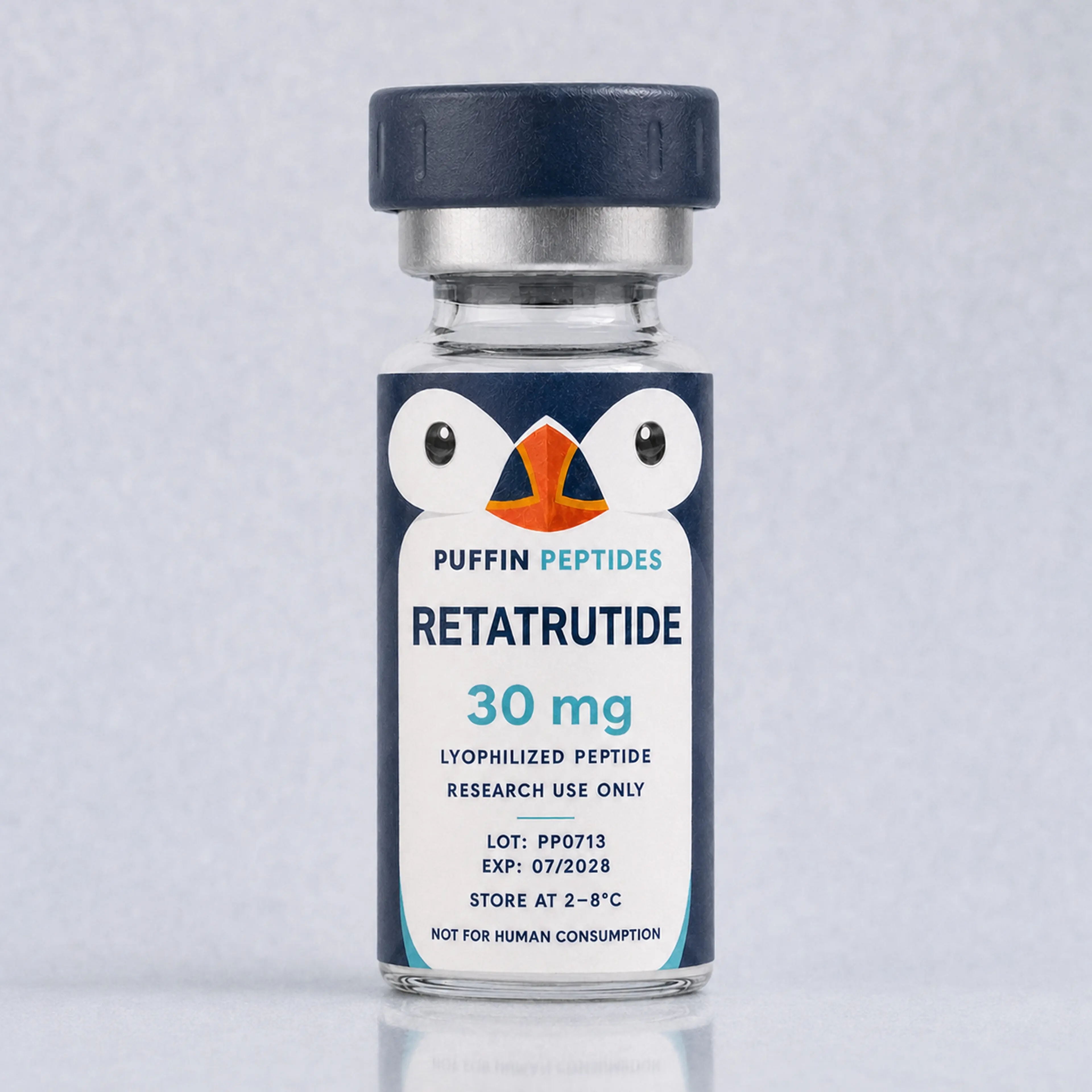
Explore RETATRUTIDE
Review available strengths, pricing, stock status, and product documentation.