
At a glance
- Semaglutide is a long-acting GLP-1 receptor agonist. It is useful in research as a single-pathway reference: one established incretin signal that can be compared with newer dual agonists, triple agonists, and amylin combinations.
- Semaglutide is the active ingredient in approved prescription medicines. This independently labelled Puffin vial is laboratory research material—not Ozempic, Wegovy, Rybelsus, a compounded prescription, or evidence of pharmaceutical equivalence.
- Use semaglutide as the single GLP-1 reference when comparing receptor-selective, dual-, or triple-agonist designs.
- Track glucose-dependent insulin, glucagon, food-intake, or gastric-emptying endpoints separately so one signal is not used to explain every outcome.
What SEMAGLUTIDE is—and what the name does not establish
Semaglutide is a long-acting GLP-1 receptor agonist. It is useful in research as a single-pathway reference: one established incretin signal that can be compared with newer dual agonists, triple agonists, and amylin combinations.
GLP-1 receptor activation increases glucose-dependent insulin signalling, reduces inappropriate glucagon signalling, and affects food-intake and gastric-emptying pathways. In plain language, it helps researchers follow one well-characterized metabolic signal without the extra receptor activity built into tirzepatide or retatrutide.
Questions to settle before interpreting a result
A useful SEMAGLUTIDE study begins with material identity, a defined model, a relevant comparator, and an endpoint chosen before the result is known. Broad catalogue language cannot replace those controls.
- Use semaglutide as the single GLP-1 reference when comparing receptor-selective, dual-, or triple-agonist designs.
- Track glucose-dependent insulin, glucagon, food-intake, or gastric-emptying endpoints separately so one signal is not used to explain every outcome.
- Match exposure, formulation, model, and observation period before comparing semaglutide with a newer incretin candidate.
How to read the SEMAGLUTIDE evidence
These evidence snapshots summarize the most important distinctions in the published record. They do not combine unlike models or turn an experimental signal into a human-use claim.
Human evidence · high
- Design
- The molecule has a large randomized-trial evidence base
- Finding
- Large clinical programmes have studied defined pharmaceutical semaglutide products in diabetes, obesity, and cardiovascular-outcome settings. That makes the pathway well characterized in people, but it does not validate an independently sourced research vial.
- Read with care
- Keep the finding attached to the linked study’s exact material, design, population, exposure, and endpoint.
Best comparison
- Design
- One receptor versus two or three
- Finding
- Semaglutide gives researchers a GLP-1-only comparator. Tirzepatide adds GIP-receptor activity; retatrutide adds both GIP- and glucagon-receptor activity. Those designs should not be described as stronger versions of the same molecule.
- Read with care
- This is an interpretation boundary, not a claim that a specific outcome has been established in people.
What not to assume
- Design
- Ingredient name does not establish product equivalence
- Finding
- Clinical outcomes depend on the exact drug product, dose, manufacturing controls, population, and protocol. An ingredient name on a research label does not transfer those outcomes to this material.
- Read with care
- This is an interpretation boundary, not a claim that a specific outcome has been established in people.
What the evidence does not establish
Semaglutide is the active ingredient in approved prescription medicines. This independently labelled Puffin vial is laboratory research material—not Ozempic, Wegovy, Rybelsus, a compounded prescription, or evidence of pharmaceutical equivalence.
Mechanism, cell, animal, observational, and controlled human evidence answer different questions. A positive result at one level cannot be silently promoted to another, and evidence for a sponsor’s defined product does not establish equivalence for an independently sourced research material.
Keep the publication and the vial separate
A published paper identifies its own sequence or chemical identity, formulation, manufacturing context, analytical controls, exposure, and test system. Matching a familiar name on a label is not enough to show that a catalogue vial is the same study material.
For practical research planning, verify the lot-specific identity and documentation, then write the model, comparator, endpoint, and stopping criteria before testing. This guide does not provide preparation, dosing, injection, or human-use instructions.
Sources
Links lead to the paper, official registry, regulator page, or product label used for this guide. Registry records describe protocols and status; they are not treated as positive results.
- Semaglutide and cardiovascular outcomes in obesity without diabetesPeer-reviewed publication · 2023
Large clinical programmes have studied defined pharmaceutical semaglutide products in diabetes, obesity, and cardiovascular-outcome settings. That makes the pathway well characterized in people, but it does not validate an independently sourced research vial. The result remains tied to the exact study material, design, population, and endpoint.
- Think twice before injecting peptides bought online: unauthorized products can seriously harm youHealth Canada · 2026
Official Canadian advisory explaining that a research-use label does not establish authorization, safety, efficacy, or product quality for human use.
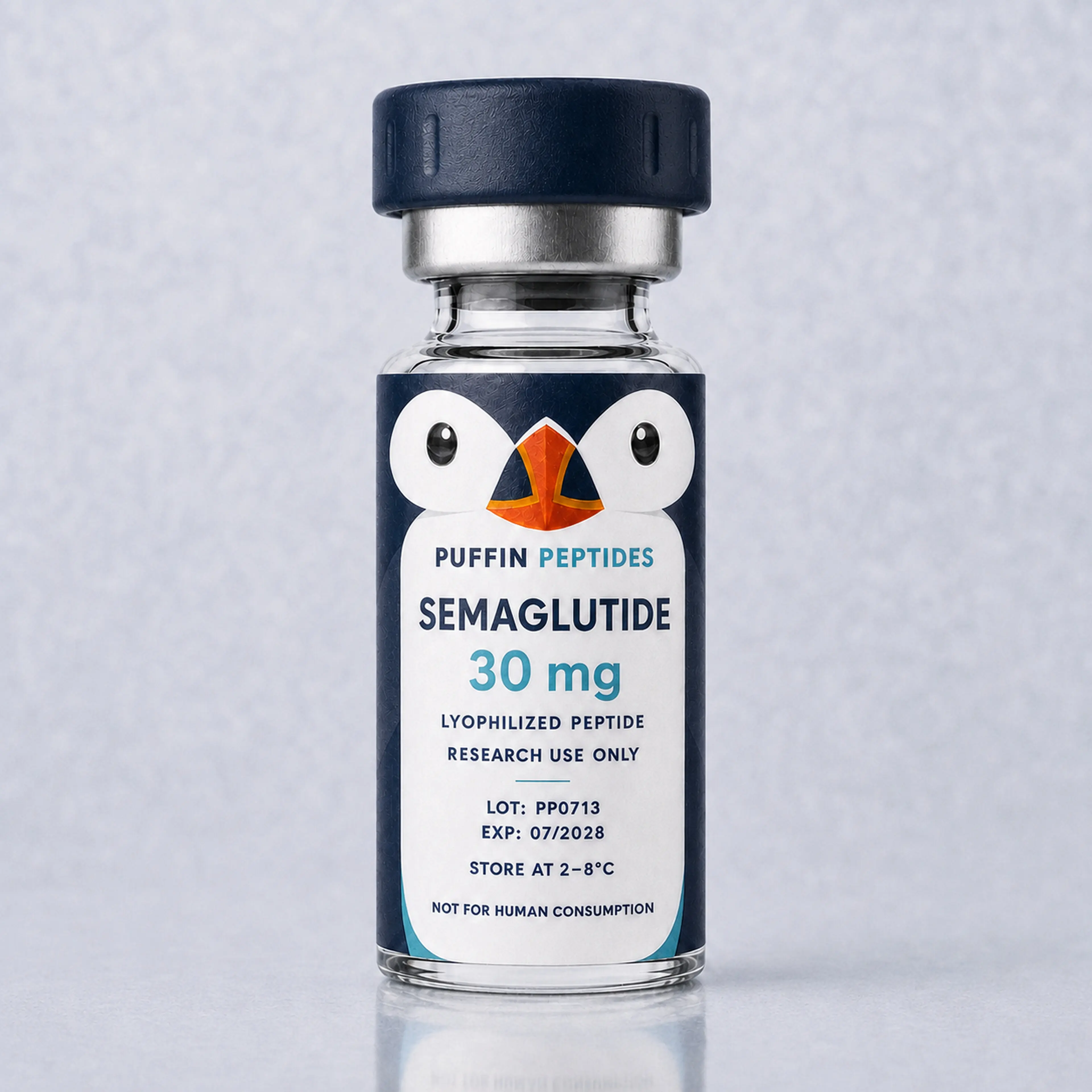
Explore SEMAGLUTIDE
Review available strengths, pricing, stock status, and product documentation.