
At a glance
- SLU-PP-332 is a synthetic small-molecule agonist of estrogen-related receptors, with activity across ERR alpha, beta, and gamma. Despite its catalogue placement, it is not a peptide and does not activate estrogen receptors.
- SLU-PP-332 is not an approved medicine and has no established human clinical evidence. Reported endurance and metabolic findings come from cell and mouse studies and should not be marketed as a human exercise substitute.
- Measure ERR target-gene engagement and use receptor-deficient controls before assigning a response to ERR agonism.
- Separate acute endurance endpoints from chronic mitochondrial, muscle-fibre, and metabolic changes.
What SLU-PP-332 is—and what the name does not establish
SLU-PP-332 is a synthetic small-molecule agonist of estrogen-related receptors, with activity across ERR alpha, beta, and gamma. Despite its catalogue placement, it is not a peptide and does not activate estrogen receptors.
ERRs are nuclear receptors that help regulate mitochondrial and oxidative-metabolism genes. SLU-PP-332 can turn on parts of that transcriptional programme in experimental systems. In plain language, it imitates selected molecular features of aerobic training—not exercise itself.
Questions to settle before interpreting a result
A useful SLU-PP-332 study begins with material identity, a defined model, a relevant comparator, and an endpoint chosen before the result is known. Broad catalogue language cannot replace those controls.
- Measure ERR target-gene engagement and use receptor-deficient controls before assigning a response to ERR agonism.
- Separate acute endurance endpoints from chronic mitochondrial, muscle-fibre, and metabolic changes.
- Classify the material as a small molecule and use chemistry-appropriate identity and purity methods.
How to read the SLU-PP-332 evidence
These evidence snapshots summarize the most important distinctions in the published record. They do not combine unlike models or turn an experimental signal into a human-use claim.
Mouse study
- Design
- An aerobic-exercise-like gene programme increased endurance
- Finding
- A 2023 study reported ERR-dependent transcriptional and endurance effects in mice. It supports ERR agonism as a research strategy, not the claim that a compound replaces exercise in people.
- Read with care
- Keep the finding attached to the linked study’s exact material, design, population, exposure, and endpoint.
Metabolic model
- Design
- Later mouse work reported effects in metabolic syndrome
- Finding
- Diet-induced mouse models showed changes in energy expenditure and metabolic endpoints. Human exposure, safety, and clinical effectiveness remain unknown.
- Read with care
- This is an interpretation boundary, not a claim that a specific outcome has been established in people.
Catalogue correction
- Design
- This is not a peptide—and ERR is not ER
- Finding
- Estrogen-related receptors are a distinct orphan nuclear-receptor family. The similar name should not be used to imply estrogen-receptor activity.
- Read with care
- This is an interpretation boundary, not a claim that a specific outcome has been established in people.
What the evidence does not establish
SLU-PP-332 is not an approved medicine and has no established human clinical evidence. Reported endurance and metabolic findings come from cell and mouse studies and should not be marketed as a human exercise substitute.
Mechanism, cell, animal, observational, and controlled human evidence answer different questions. A positive result at one level cannot be silently promoted to another, and evidence for a sponsor’s defined product does not establish equivalence for an independently sourced research material.
Keep the publication and the vial separate
A published paper identifies its own sequence or chemical identity, formulation, manufacturing context, analytical controls, exposure, and test system. Matching a familiar name on a label is not enough to show that a catalogue vial is the same study material.
For practical research planning, verify the lot-specific identity and documentation, then write the model, comparator, endpoint, and stopping criteria before testing. This guide does not provide preparation, dosing, injection, or human-use instructions.
Sources
Links lead to the paper, official registry, regulator page, or product label used for this guide. Registry records describe protocols and status; they are not treated as positive results.
- A synthetic estrogen-related receptor agonist produces an exercise-like programme in micePeer-reviewed publication · 2023
A 2023 study reported ERR-dependent transcriptional and endurance effects in mice. It supports ERR agonism as a research strategy, not the claim that a compound replaces exercise in people. The result remains tied to the exact study material, design, population, and endpoint.
- Think twice before injecting peptides bought online: unauthorized products can seriously harm youHealth Canada · 2026
Official Canadian advisory explaining that a research-use label does not establish authorization, safety, efficacy, or product quality for human use.
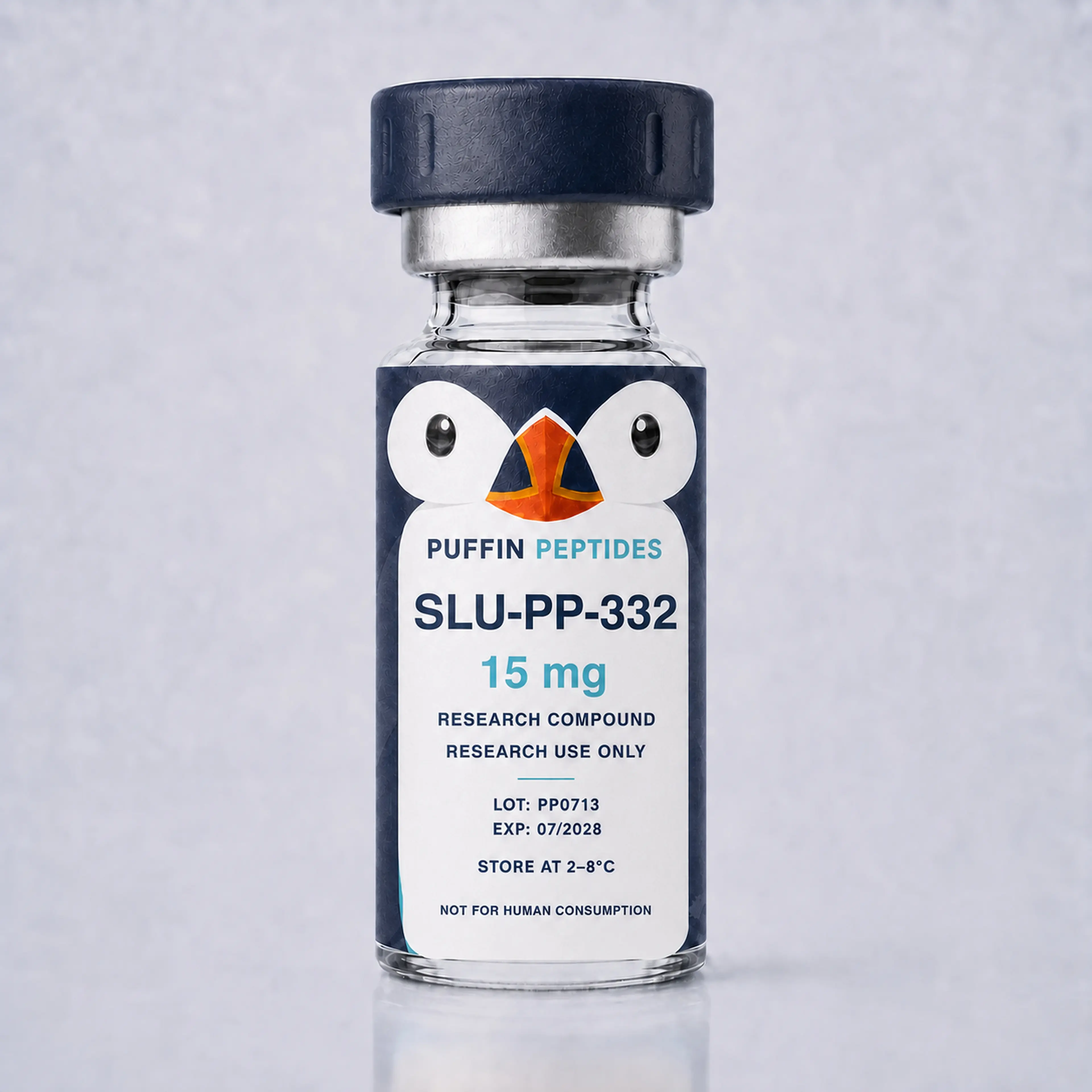
Explore SLU-PP-332
Review available strengths, pricing, stock status, and product documentation.