
At a glance
- Survodutide is an investigational single molecule that activates GLP-1 and glucagon receptors. Its development programme studies both body-weight and liver-disease questions, reflecting the different biology contributed by the two receptors.
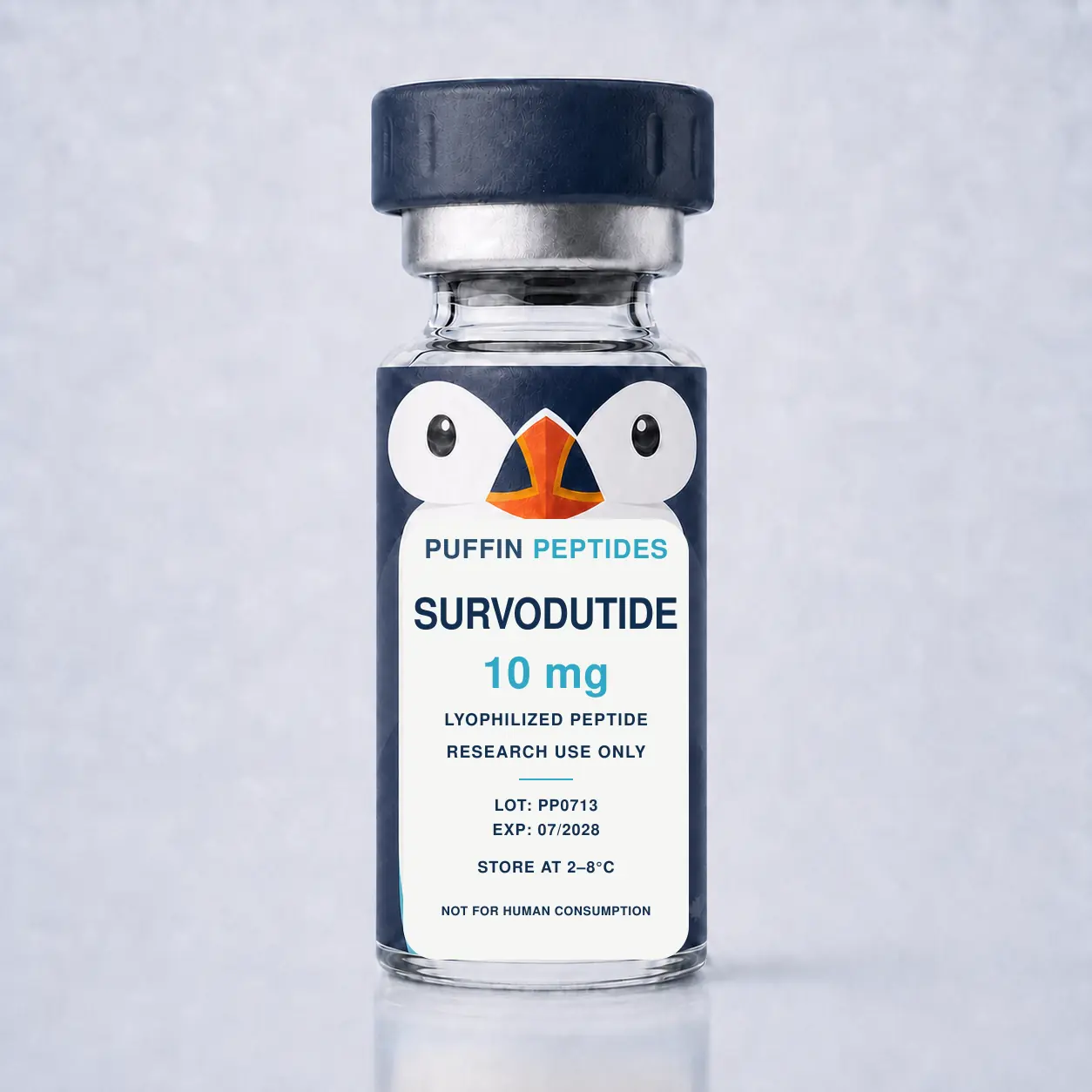
- Survodutide remains investigational as of July 2026. Phase 3 topline results have been reported, but regulatory review and full product labelling are not complete; this research vial is not Boehringer Ingelheim and Zealand Pharma’s clinical product.
- Compare with a GLP-1-only reference to isolate glucagon-receptor contributions.
- Measure liver-fat, hepatic, glucose, food-intake, and body-composition endpoints separately.
What SURVODUTIDE is—and what the name does not establish
Survodutide is an investigational single molecule that activates GLP-1 and glucagon receptors. Its development programme studies both body-weight and liver-disease questions, reflecting the different biology contributed by the two receptors.
GLP-1-receptor activity contributes food-intake and glucose-dependent signalling; glucagon-receptor activity adds hepatic and energy-metabolism effects. In plain language, the dual design aims to combine appetite-related and liver/energy pathways in one balanced molecule.
Questions to settle before interpreting a result
A useful SURVODUTIDE study begins with material identity, a defined model, a relevant comparator, and an endpoint chosen before the result is known. Broad catalogue language cannot replace those controls.
- Compare with a GLP-1-only reference to isolate glucagon-receptor contributions.
- Measure liver-fat, hepatic, glucose, food-intake, and body-composition endpoints separately.
- Use mazdutide or retatrutide as comparators only when receptor balance and the added GIP pathway are explicitly controlled.
How to read the SURVODUTIDE evidence
These evidence snapshots summarize the most important distinctions in the published record. They do not combine unlike models or turn an experimental signal into a human-use claim.
Phase 2 · peer reviewed
- Design
- Clinical signals have been reported in obesity and MASH programmes
- Finding
- Randomized trials of the sponsor’s defined survodutide product reported body-weight and liver-disease signals. Trial population, titration, estimand, and product identity are part of those results.
- Read with care
- Keep the finding attached to the linked study’s exact material, design, population, exposure, and endpoint.
Phase 3 · current context
- Design
- Topline success is not yet an approval
- Finding
- Sponsor-reported late-stage results are important development news, but full peer-reviewed analyses and regulatory review remain separate steps.
- Read with care
- This is an interpretation boundary, not a claim that a specific outcome has been established in people.
Best comparison
- Design
- Same receptor pair does not make mazdutide identical
- Finding
- Survodutide and mazdutide both target GLP-1 and glucagon receptors, but molecular structure, receptor balance, exposure, and clinical programmes differ.
- Read with care
- This is an interpretation boundary, not a claim that a specific outcome has been established in people.
What the evidence does not establish
Survodutide remains investigational as of July 2026. Phase 3 topline results have been reported, but regulatory review and full product labelling are not complete; this research vial is not Boehringer Ingelheim and Zealand Pharma’s clinical product.
Mechanism, cell, animal, observational, and controlled human evidence answer different questions. A positive result at one level cannot be silently promoted to another, and evidence for a sponsor’s defined product does not establish equivalence for an independently sourced research material.
Keep the publication and the vial separate
A published paper identifies its own sequence or chemical identity, formulation, manufacturing context, analytical controls, exposure, and test system. Matching a familiar name on a label is not enough to show that a catalogue vial is the same study material.
For practical research planning, verify the lot-specific identity and documentation, then write the model, comparator, endpoint, and stopping criteria before testing. This guide does not provide preparation, dosing, injection, or human-use instructions.
Sources
Links lead to the paper, official registry, regulator page, or product label used for this guide. Registry records describe protocols and status; they are not treated as positive results.
- the peer-reviewed MASH trialPeer-reviewed publication · Linked record
Randomized trials of the sponsor’s defined survodutide product reported body-weight and liver-disease signals. Trial population, titration, estimand, and product identity are part of those results. The result remains tied to the exact study material, design, population, and endpoint.
- Think twice before injecting peptides bought online: unauthorized products can seriously harm youHealth Canada · 2026
Official Canadian advisory explaining that a research-use label does not establish authorization, safety, efficacy, or product quality for human use.
Vote for SURVODUTIDE
This compound is not currently stocked. Add it to your five-choice catalogue ballot.