
At A Glance
- Peptides are chains of amino acids—the same building blocks found in proteins.
- Small changes to a sequence can change what a molecule does.
- Knowing what a study measured makes its findings easier to understand.
- A COA helps explain a tested sample; identity, purity, and content answer different questions.
What Is A Peptide, In Normal Language?
A peptide is a chain of amino acids. Think of those amino acids as building blocks: changing their order can change the finished molecule, just as rearranging letters changes a word.
Some peptides resemble signals the body already makes. Others have been modified to explore a particular question, such as how long a signal lasts or which receptor it reaches. There is no single job shared by every peptide.
You will also see a few non-peptides in this library, such as NAD+ and L-Carnitine. They belong to related research conversations, but their chemistry is different.
How Can Something So Small Send A Signal?
Many peptides bind to receptors, places where cells receive chemical messages. An agonist activates a receptor response; an antagonist blocks or reduces one. Other molecules work through enzymes or by binding another signal.
The surroundings matter too. Different cells have different receptors and respond in different ways. That is why a paper tells you which cells or tissues were studied, rather than simply saying a molecule is active.
Milligrams measure mass, not biological potency. A 10 mg label tells you an amount, not that one compound is stronger than another or that the vial amount is a personal dose.
How To Make Sense Of The Studies
You do not have to rank every paper. Start with one simple question: what did this study actually look at? These are the main kinds you will see.
| Study or context | What was explored | What it tells us | Useful context |
|---|---|---|---|
| Cell and biochemical studies | A controlled look at cells, receptors, or chemical reactions. | These experiments help explain how a molecule works and which signals change. | They focus on a small part of the biology rather than a whole person. |
| Animal studies | A look at effects in a living system, often around a specific injury or condition. | Researchers can connect cellular signals with tissue or functional responses. | The species and model help define what the result means. |
| Early human trials | Initial studies of a defined formulation in a selected group. | They explore tolerability, how a substance behaves, and early responses. | Smaller studies are a starting point for larger, longer follow-up. |
| Larger human trials | Studies comparing treatments and predefined outcomes in larger groups. | They can give a clearer estimate of outcomes for the population studied. | A registry describes a study plan; a results paper reports what happened. |
What Am I Looking At On A Product Page?
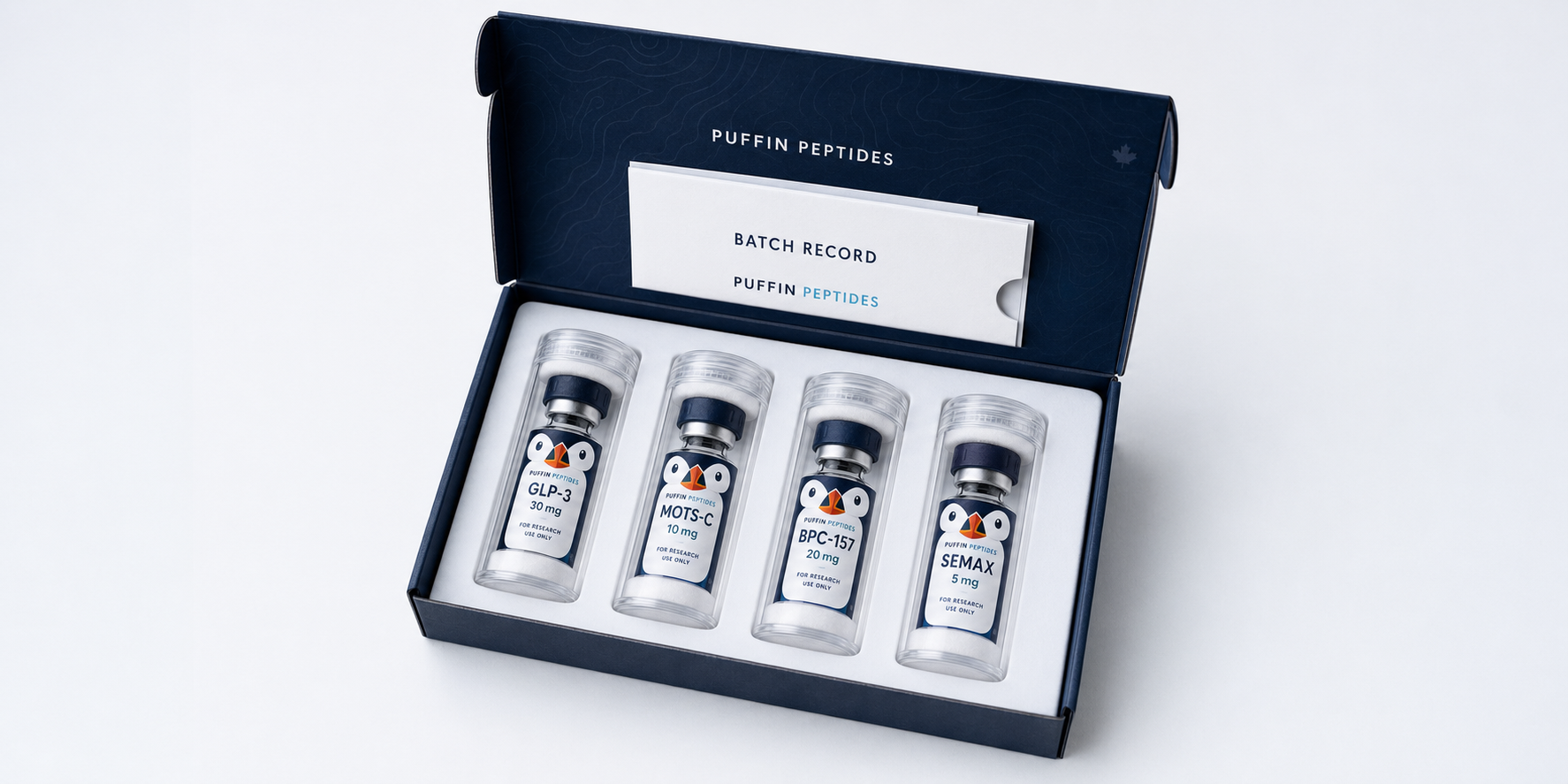
Start with the compound name, then the variant. The name tells you the research subject; the variant tells you the labelled presentation, such as a particular vial strength. They are related details, not the same thing.
Lyophilized simply means freeze-dried. A prepared solution is already liquid, while a diluent is a separate supply. Those words tell you the format without needing to guess from a photo.
A batch or lot number connects a material with its own records. The general product description explains the compound; matching batch documentation explains what was tested for that particular lot.
How Do I Read A COA Without Getting Lost?
A certificate of analysis, or COA, summarizes testing on a sample. Start by checking what was tested and which lot the report belongs to. Then look at the actual tests rather than relying on the appearance of the PDF.
Identity asks “is it the expected molecule?” Purity asks about the relative amount of target and related material detected by a method. Content, sometimes called assay, asks how much target material is present. These are useful answers to different questions.
For example, “99% purity” does not necessarily mean 99% of everything in the vial is active peptide. A chromatographic result compares what that method detects. It does not by itself measure every other component or confirm the labelled mass.
Sterility and endotoxin are separate tests too. Once you know that, the document becomes less mysterious: each line tells you one thing, and the report’s scope tells you how much was actually checked.
A Small Glossary That Makes A Big Difference
These words come up often. A plain-language translation is usually enough to get you back into the interesting part of the guide.
- Analogue: a modified relative of another molecule.
- Agonist: a molecule that activates a receptor response.
- Antagonist: a molecule that blocks or reduces a receptor response.
- Affinity: how strongly a molecule binds in the conditions being studied.
- Potency: how much is needed for a defined response in a particular test.
- Efficacy: the size of the maximum response in that system.
- Pharmacokinetics: what happens to a substance over time in the body.
- Pharmacodynamics: what the substance does to the biological system.
- In vitro and in vivo: outside a living organism and within a living organism.
- Endpoint: the measurement chosen to answer a study’s question.
How Can I Tell Whether An Article Is Useful?
Look for the actual question, the comparison, and the result. Was the study measuring cell movement, blood sugar, skin appearance, or something else? A specific answer is usually more useful than a broad promise.
Then check the people, animals, or cells involved and how long the study ran. Two impressive percentages can describe very different experiments. Keeping that context beside the number makes comparisons fairer.
The source links in each Puffin guide are there for when you want to go further. You can understand the main idea here, then open the original record for the detail.
How Do Studies And Product Records Fit Together?
A clinical study describes its own formulation and participants. A COA describes a tested material or batch. One explains an experiment; the other explains a sample. They complement each other but do not do the same job.
Research material is not an approved medicine. The existing research-use framework and linked Health Canada information explain that distinction; the guides help you understand the biology without turning it into personal treatment instructions.
Common Questions About Peptides 101
What is a peptide?+
A peptide is a chain of amino acids. Think of those amino acids as building blocks: changing their order can change the finished molecule, just as rearranging letters changes a word.
Does a higher mg number mean a stronger peptide?+
Milligrams measure mass, not biological potency. A 10 mg label tells you an amount, not that one compound is stronger than another or that the vial amount is a personal dose.
What does a peptide COA tell me?+
Identity asks “is it the expected molecule?” Purity asks about the relative amount of target and related material detected by a method. Content, sometimes called assay, asks how much target material is present. These are useful answers to different questions.
Sources
Want to go a little deeper? These links take you to the studies and official records behind the guide. Study registries describe the plan; published papers report the findings.
- Definition of peptideU.S. National Cancer Institute · Current dictionary
Plain-language definition of peptides as amino-acid chains.
- Learn About StudiesClinicalTrials.gov · Updated 2026
Official explanation of clinical-study types, phases, and study design.
- How to Read a Study RecordClinicalTrials.gov · Updated 2026
Official guide to interpreting registry fields and status information.
- Q6A Specifications: Test Procedures and Acceptance CriteriaU.S. Food and Drug Administration · Current guidance
Authoritative distinction among identity, assay, impurities, and other specifications.
- Analytical Procedures and Methods Validation for Drugs and BiologicsU.S. Food and Drug Administration · 2015
Guidance on methods supporting identity, strength, quality, purity, and potency.
- Think twice before injecting peptides bought onlineHealth Canada · 2026
Official warning about unauthorized injectable peptide products and human-use risks.