
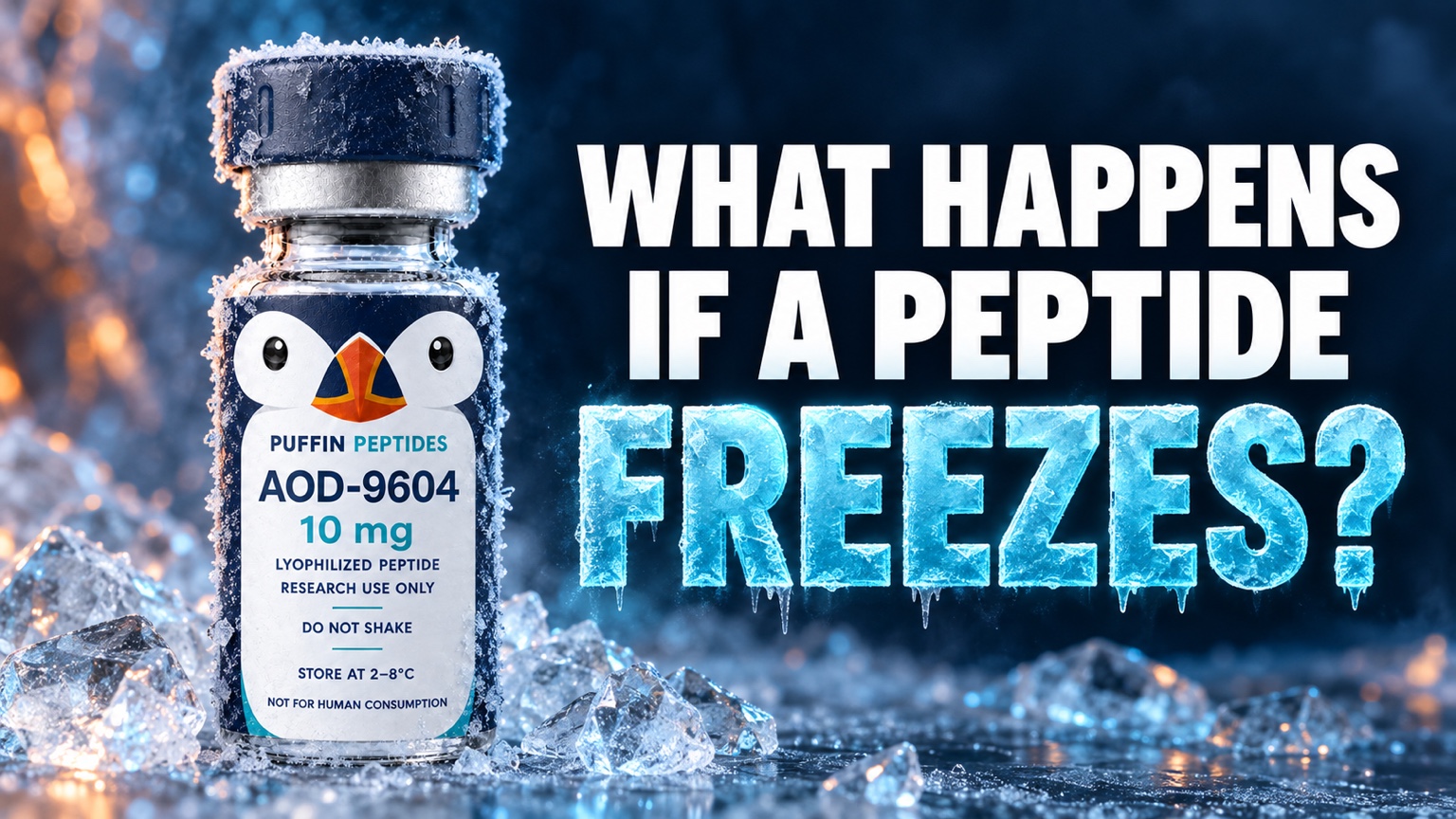
At A Glance
- A dry freeze dried cake is not the same physical system as a liquid solution that accidentally freezes.
- Freezing a solution can concentrate salts and solutes into the remaining liquid phase and change local pH or interfaces.
- Repeated freeze thaw cycles may increase aggregation or particles in susceptible formulations.
- Do not assume a household freezer preserves every peptide or copy a no freeze rule from an unrelated product.
Is A Freeze Dried Vial Already Frozen?
Freeze drying uses a controlled freezing step during manufacture, followed by removal of ice under vacuum. The finished dry cake is no longer a frozen liquid. Accidentally freezing a prepared solution is a different event because water, peptide, salts, and excipients separate and concentrate as ice forms.
That concentration can expose the molecule to local changes in pH, ionic strength, surfaces, and crowding. Whether those changes matter depends strongly on the molecule and formulation.
Why Can Freeze And Thaw Cycles Cause Problems?
Research on protein formulations shows that freezing rate, thawing rate, buffer, salt, concentration, surfaces, and number of cycles can change aggregation outcomes. Some formulations tolerate defined cycles while others do not.
A product label that says do not freeze should be treated as a product-specific boundary. If accidental freezing occurs, appearance alone cannot confirm that potency and purity remain unchanged.
Which Part Of The Freezing Event Matters?
The word frozen leaves out several variables that can change the outcome.
| Study or context | What was explored | What it tells us | Useful context |
|---|---|---|---|
| Physical state | Dry cake versus liquid formulation | Defines whether ice formation and freeze concentration can occur | Dry appearance still does not prove stability |
| Freeze thaw history | Temperature, rate, duration, and number of cycles | Describes the actual stress applied | A household freezer does not provide a validated cycle |
| Post stress testing | Appearance plus suitable purity, particle, and potency methods | Can detect specified changes after freezing | One passing test cannot establish every quality attribute |
What Should I Do After Accidental Freezing?
Keep the container closed, record the lot, approximate temperature and duration, and whether the material was dry or liquid. Follow the approved label for a medicine or ask the supplier for freeze thaw data for that exact formulation. Do not repeatedly warm and refreeze it while deciding.
A supplier's answer should identify the tested cycle and acceptance criteria. General statements that peptides love the freezer are not a substitute for data.
Common Questions About Frozen Peptide Questions
Is a freeze dried peptide the same as a frozen peptide solution?+
No. Freeze drying removes ice after a controlled freezing step. A finished dry cake and a liquid that accidentally freezes are different physical systems.
Can I tell whether freezing damaged a peptide by looking at it?+
Only obvious appearance changes may be visible. Suitable analytical testing and product-specific freeze thaw data are needed to evaluate less visible changes.
Is one freeze thaw cycle always safe?+
No universal answer applies. Tolerance depends on the exact molecule, formulation, container, cycle conditions, and acceptance criteria.
Sources
Want to go a little deeper? These links take you to the studies and official records behind the guide. Study registries describe the plan; published papers report the findings.
- Q5C Quality of Biotechnological Products: Stability TestingInternational Council for Harmonisation · 1995
Explains why proteins and peptides can be sensitive to temperature, oxidation, light, ionic content, and shear, and why no single assay describes stability.
- Freeze Thaw Characterization Process to Minimize Aggregation and Enable Drug Product ManufacturingAAPS PharmSciTech · 2021
Demonstrates that freezing rate, thawing, cycle count, concentration, salt, and buffer can change aggregation in a model protein formulation.
- Effects of Tween 80 and Sucrose on Freeze Thaw and Frozen Storage StabilityJournal of Pharmaceutical Sciences · 1998
Shows that excipients and storage conditions changed freeze thaw aggregation and long-term frozen stability in the studied protein formulation.