
At A Glance
- CagriSema contains two distinct molecules: cagrilintide and semaglutide.
- Cagrilintide explores the amylin pathway; semaglutide targets GLP-1.
- The REDEFINE trials followed body-weight and metabolic outcomes over 68 weeks.
What Is CagriSema?
CagriSema is the development name for cagrilintide and semaglutide studied together. It is easy to remember as two ingredients with different jobs in a related conversation: how the body responds to food.
Cagrilintide is a longer-acting version of amylin, a hormone released alongside insulin. Amylin is involved in fullness and meal handling. Semaglutide activates GLP-1 receptors, connecting with appetite, stomach emptying, and blood-sugar signals.
The combination is two molecules, unlike tirzepatide, which is one molecule designed to engage two receptors. That small distinction makes the names much easier to keep straight.
Why Put Amylin And GLP-1 Together?
Feeling full is not controlled by one single message. Amylin and GLP-1 use different receptors, even though both can influence food intake. Studying them together lets scientists ask whether the signals complement each other.
The interesting question is what each ingredient contributes. A trial that includes the individual components as well as the combination gives a clearer picture than testing the pair alone. Researchers also track tolerability, because how comfortably people remain on a study treatment affects its results.
What The REDEFINE Trials Found
The REDEFINE trials give this combination a substantial human dataset. Here are the main findings, with the study population and the meaning of the percentages kept beside them.
| Study or context | What was explored | What it tells us | Useful context |
|---|---|---|---|
| REDEFINE 1 · adults without type 2 diabetes | 3,417 adults with overweight or obesity were assigned to CagriSema, cagrilintide, semaglutide, or placebo alongside lifestyle intervention. | Using the trial-product estimand, mean body-weight change at week 68 was −22.7% with CagriSema and −2.3% with placebo. The treatment-policy estimate was −20.4% versus −3.0%. | The trial allowed flexible dose increases. At week 68, 57.3% of the CagriSema group were receiving the highest dose, so the headline is not a result from everyone following an identical schedule. |
| REDEFINE 2 · adults with type 2 diabetes | 1,206 adults with overweight or obesity and type 2 diabetes were randomized to CagriSema or placebo for 68 weeks. | The treatment-policy estimate for mean body-weight change was −13.7% with CagriSema and −3.4% with placebo. A glycated haemoglobin level of 6.5% or lower was reported in 73.5% versus 15.9%. | This study involved people with type 2 diabetes. That is a different population from REDEFINE 1 and helps explain why the averages differ. |
| Tolerability signal | Both trials recorded side effects while allowing flexible dose increases. | Gastrointestinal events were the most common adverse events and were generally described as transient and mild to moderate. | Even temporary symptoms can affect whether someone continues treatment or reaches the target dose. |
Why Do Different Articles Quote Different Percentages?
You may see more than one number from the same trial. That does not automatically mean an article is wrong. A trial-product estimate asks a question closer to continued assigned treatment. A treatment-policy estimate also accounts for what happens when participants stop or change treatment.
In REDEFINE 1, that is why both −22.7% and −20.4% appear for CagriSema. They answer different statistical questions. Keeping the estimate’s name attached to the number makes the result much easier to compare.
An average also includes a range of individual responses. The useful picture combines the average change, the people studied, how long they were followed, and how many stayed on treatment.
What Makes The Combination Worth Following?
CagriSema adds another way to explore appetite-related biology: two distinct molecules working through different receptor systems. The component groups in REDEFINE 1 are especially useful for understanding that design.
Further questions concern how the response holds up over time, how the ingredients contribute, and how tolerability shapes the experience. Those are more informative than simply asking whether two ingredients must be better than one.
Connecting A Study With A Product Label
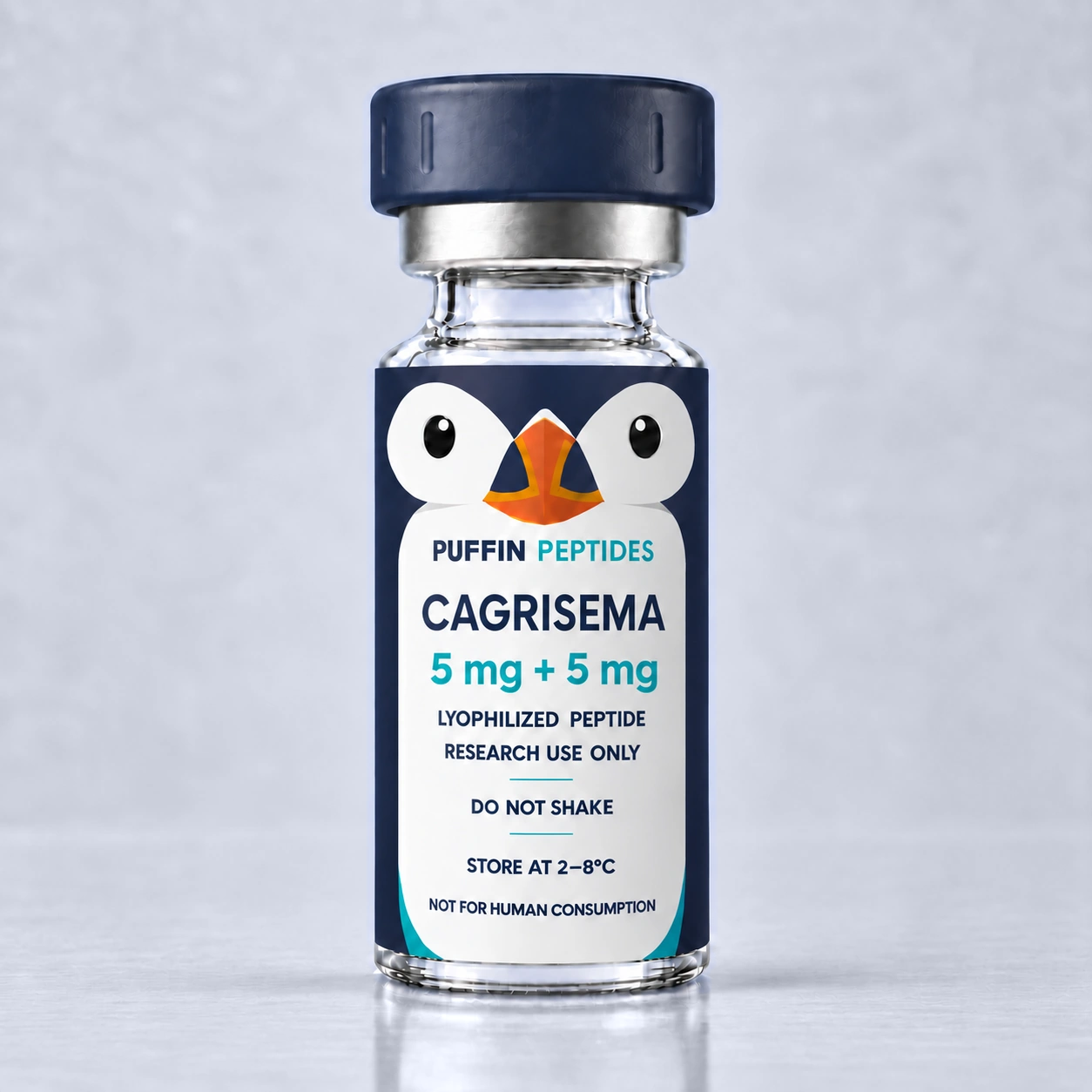
The trials describe a controlled clinical formulation. A separate research vial needs its own identity and batch documentation. A study explains the biology; the batch record explains the material. They are useful for different reasons.
Common Questions About CagriSema
What is in CagriSema?+
CagriSema is the development name for cagrilintide and semaglutide studied together. It is easy to remember as two ingredients with different jobs in a related conversation: how the body responds to food.
How is CagriSema different from tirzepatide?+
CagriSema pairs two molecules, cagrilintide and semaglutide. Tirzepatide is one engineered molecule targeting GIP and GLP-1 receptors. They explore different combinations of food-related signals.
Why are there different CagriSema weight-loss percentages?+
You may see more than one number from the same trial. That does not automatically mean an article is wrong. A trial-product estimate asks a question closer to continued assigned treatment. A treatment-policy estimate also accounts for what happens when participants stop or change treatment.
Sources
Want to go a little deeper? These links take you to the studies and official records behind the guide. Study registries describe the plan; published papers report the findings.
- Coadministered Cagrilintide and Semaglutide in Adults with Overweight or ObesityThe New England Journal of Medicine · 2025
Peer-reviewed REDEFINE 1 phase 3a trial.
- Cagrilintide–Semaglutide in Adults with Overweight or Obesity and Type 2 DiabetesThe New England Journal of Medicine · 2025
Peer-reviewed REDEFINE 2 phase 3a trial.
- Research Study to See How Well CagriSema Works in People With Excess Body WeightClinicalTrials.gov · NCT05567796 · Current record
Official registry record for REDEFINE 1.
Explore CAGRISEMA
Review available strengths, pricing, stock status, and product documentation.