
At A Glance
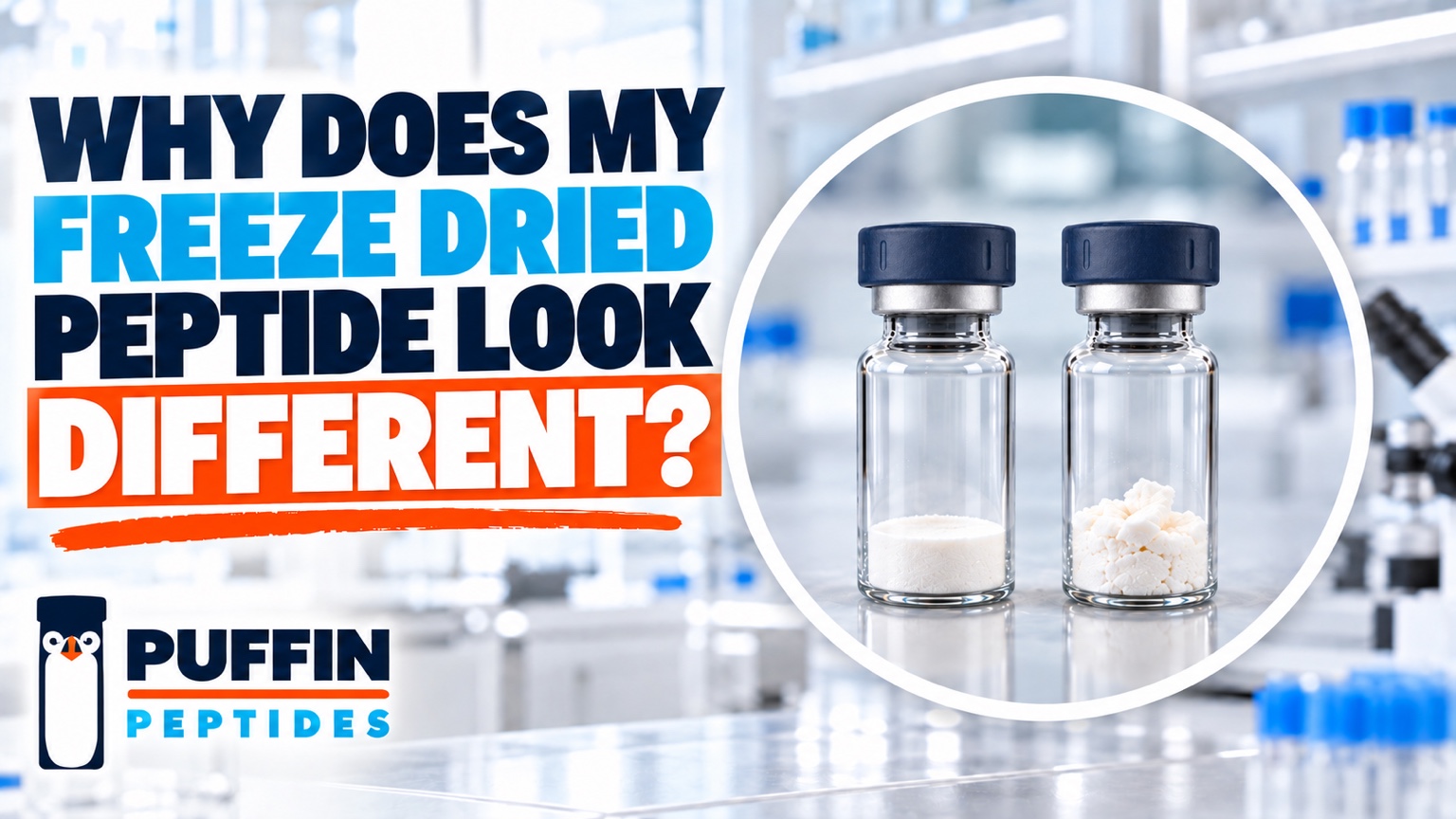
- Cracks, shrinkage, collapse, and powder movement can arise during freeze drying or later handling.
- The visible cake includes peptide plus any excipients, so cake size is not a direct measure of peptide amount.
- A neat cake is not proof of purity, identity, content, or sterility.
- Compare the vial with a written appearance specification for the same formulation and lot.
Why Can Two Freeze Dried Vials Look Different?
Freeze drying first freezes the formulation and then removes ice by sublimation. Ice nucleation, crystal growth, solute distribution, shelf temperature, chamber pressure, and drying time shape the final porous cake. Differences in those conditions can produce cracks, skins, shrinkage, or collapse.
Transport vibration can also move a fragile cake or break it into powder. Residual moisture and storage temperature can change appearance later. These observations help an investigation, but they do not identify the cause without process records and appropriate tests.
Does A Smaller Cake Mean Less Peptide?
Not necessarily. The visible solid may include bulking agents, buffers, salts, and stabilizers in addition to peptide. Density and shape can change while total dry mass stays similar, and a small amount of active material can be distributed through a larger excipient cake.
Peptide quantity is addressed by a validated content or assay method, not by comparing cake height. The label, batch record, fill controls, and analytical result are more informative than visual volume.
What Can Cake Appearance Tell You?
Appearance is a useful process and complaint signal, but it must be connected to the formulation, specification, and analytical results.
| Study or context | What was explored | What it tells us | Useful context |
|---|---|---|---|
| Uniform intact cake | Visual comparison with a defined appearance specification | May indicate consistent freezing and drying appearance | Does not prove chemical or microbiological quality |
| Cracks or shrinkage | Records structural differences in the dry cake | Can support a process or shipping investigation | Does not automatically mean the peptide amount changed |
| Collapse or colour change | Compares appearance, moisture, storage, and stability results | May signal a process or storage deviation | Severity and impact are formulation specific |
What Should I Do If The Cake Looks Unusual?
Photograph the unopened vial against a plain background, record the lot and storage history, and compare it with the supplier's written specification. Note loose powder, collapse, discoloration, seal damage, or moisture without shaking or altering the vial.
Ask whether the lot met appearance, residual moisture, identity, purity, and content specifications. A thoughtful answer should explain the evidence and whether the observation falls within the product's defined range.
Common Questions About Freeze Dried Peptide Appearance
Does a cracked freeze dried cake mean the peptide is bad?+
Not automatically. Cracking can result from freeze drying or handling, but the impact must be evaluated against the formulation, process records, appearance specification, and analytical results.
Why is there so much material in a low milligram vial?+
The cake may contain excipients as well as peptide. Visible cake volume is not a direct measurement of peptide mass.
Can a perfect looking cake still fail testing?+
Yes. Appearance cannot establish identity, content, purity, sterility, endotoxin level, or stability.
Sources
Want to go a little deeper? These links take you to the studies and official records behind the guide. Study registries describe the plan; published papers report the findings.
- Effect of Freezing on Lyophilization Process Performance and Drug Product Cake AppearanceJournal of Pharmaceutical Sciences · 2016
Shows that freezing conditions can materially affect drying performance and cake appearance, including cracks and shrinkage.
- Systematic Investigation of Lyophilizate Collapse During StorageEuropean Journal of Pharmaceutics and Biopharmaceutics · 2013
Examines collapse, residual moisture, excipient changes, reconstitution, and protein stability during stressed storage.
- Q5C Quality of Biotechnological Products: Stability TestingInternational Council for Harmonisation · 1995
Explains why proteins and peptides can be sensitive to temperature, oxidation, light, ionic content, and shear, and why no single assay describes stability.