
At A Glance
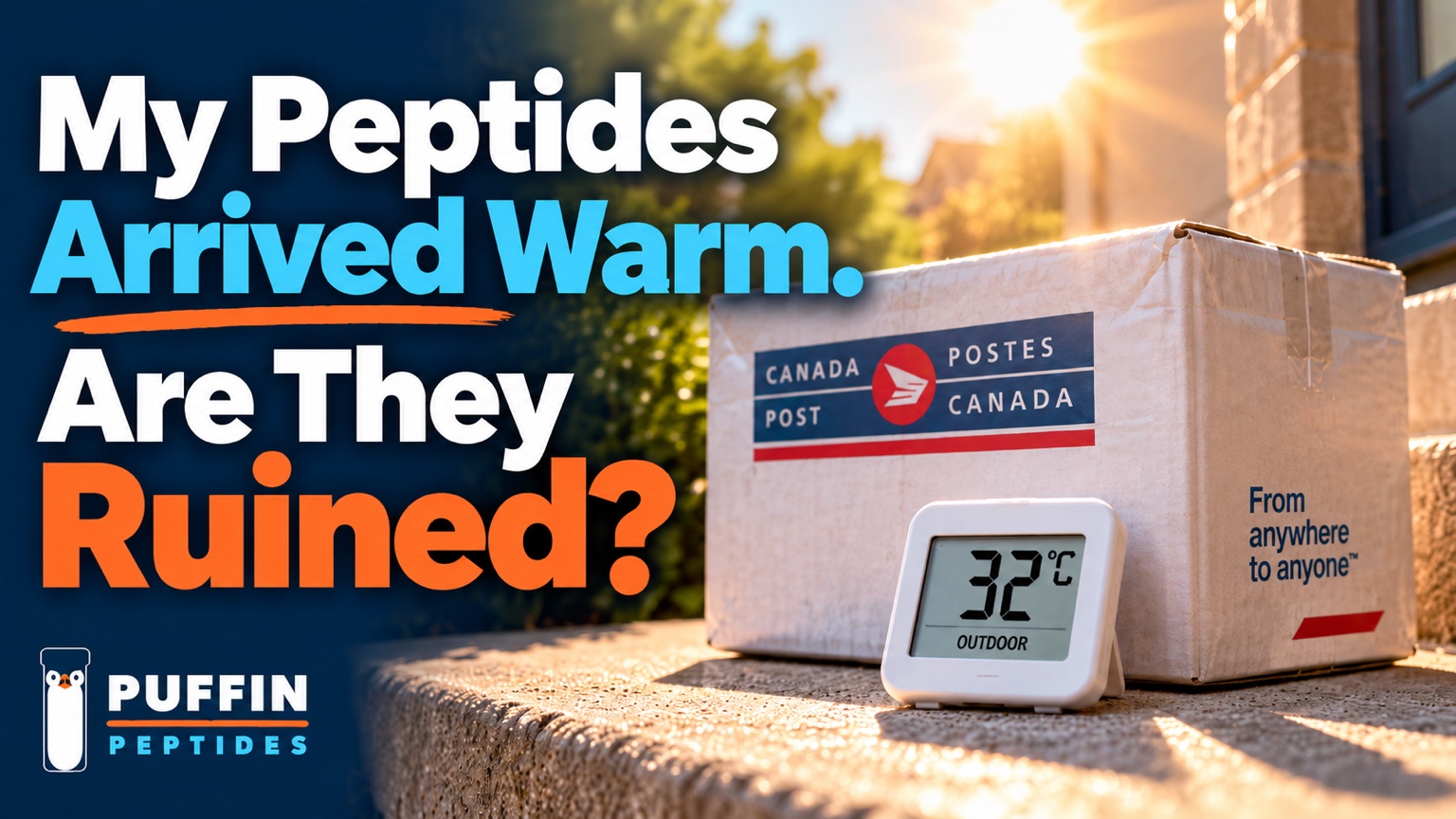
- Warm on arrival is an observation, not a complete stability assessment.
- Freeze dried material and a prepared solution may respond differently to the same trip.
- A melted ice pack does not reveal the highest temperature or how long the shipment stayed there.
- Record the condition immediately and ask the supplier for the excursion limit supported by data for that exact lot or formulation.
Does Warm Delivery Always Destroy A Peptide?
No universal rule says that every warm shipment is ruined, and no universal rule says it is fine. Peptide stability depends on sequence, formulation, moisture, container, light, oxygen, concentration, and whether the material is dry or in solution. A room temperature allowance for one approved drug cannot be copied onto another peptide.
The important evidence is an excursion study or stability program for the exact product. Without it, a seller should not invent a safe number from another label or from the fact that the package still felt cool.
What Details Matter Most After A Warm Shipment?
A useful investigation asks how hot the product may have become, for how long, and whether the route included repeated heating and cooling. A data logger is stronger evidence than touching the box. The seller should also know the labelled storage condition, shipping qualification, and what stability indicating tests were used to set an excursion allowance.
If the product is represented as a refrigerated injectable medicine, follow its approved label and contact a pharmacist or manufacturer. FDA specifically warns that unapproved injectable GLP-1 products arriving warm or without adequate refrigeration may have quality problems.
What Can And Cannot Answer The Question?
The shipment has to be compared with evidence for the same material rather than a generic internet storage chart.
| Study or context | What was explored | What it tells us | Useful context |
|---|---|---|---|
| Package feel | Touch or a melted coolant pack | Shows the parcel was not cold when opened | Does not reconstruct product temperature or excursion duration |
| Temperature logger | Records time and temperature during transit | Provides a usable shipping history | Still requires a product-specific acceptance limit |
| Stability study | Tests the exact formulation under controlled conditions | Can support a defined excursion allowance | Cannot be transferred automatically to another peptide or formulation |
What Should I Do When A Warm Package Arrives?
Keep the lot separate while the supplier investigates. Send the documented condition and ask for the labelled storage range, maximum supported excursion, study basis, and replacement policy. Do not try to erase the history by cooling or freezing the vial before recording what arrived.
Appearance can identify obvious damage, but a clear vial cannot prove that potency, purity, sterility, or stability is unchanged. The answer should come from records and data, not reassurance based only on looks.
Common Questions About Warm Peptide Delivery
Does a melted ice pack mean my peptide is ruined?+
Not by itself. It shows the coolant melted, but it does not establish the product's maximum temperature, time at temperature, or whether the exact formulation has a supported excursion allowance.
Can I use another peptide's room temperature limit?+
No. Storage allowances are product and formulation specific and should not be transferred between compounds or presentations.
Can I tell from appearance whether heat damaged it?+
Only obvious changes may be visible. A normal appearance cannot establish unchanged identity, purity, content, sterility, or potency.
Sources
Want to go a little deeper? These links take you to the studies and official records behind the guide. Study registries describe the plan; published papers report the findings.
- Q1A(R2) Stability Testing of New Drug Substances and ProductsU.S. Food and Drug Administration · 2003
Explains how labelled storage conditions and shelf life must be supported by product-specific stability studies.
- Q5C Quality of Biotechnological Products: Stability TestingInternational Council for Harmonisation · 1995
Explains why proteins and peptides can be sensitive to temperature, oxidation, light, ionic content, and shear, and why no single assay describes stability.
- FDA's Concerns with Unapproved GLP-1 Drugs Used for Weight LossU.S. Food and Drug Administration · 2026
Warns that injectable GLP-1 products arriving warm or without adequate refrigeration may have quality problems.