
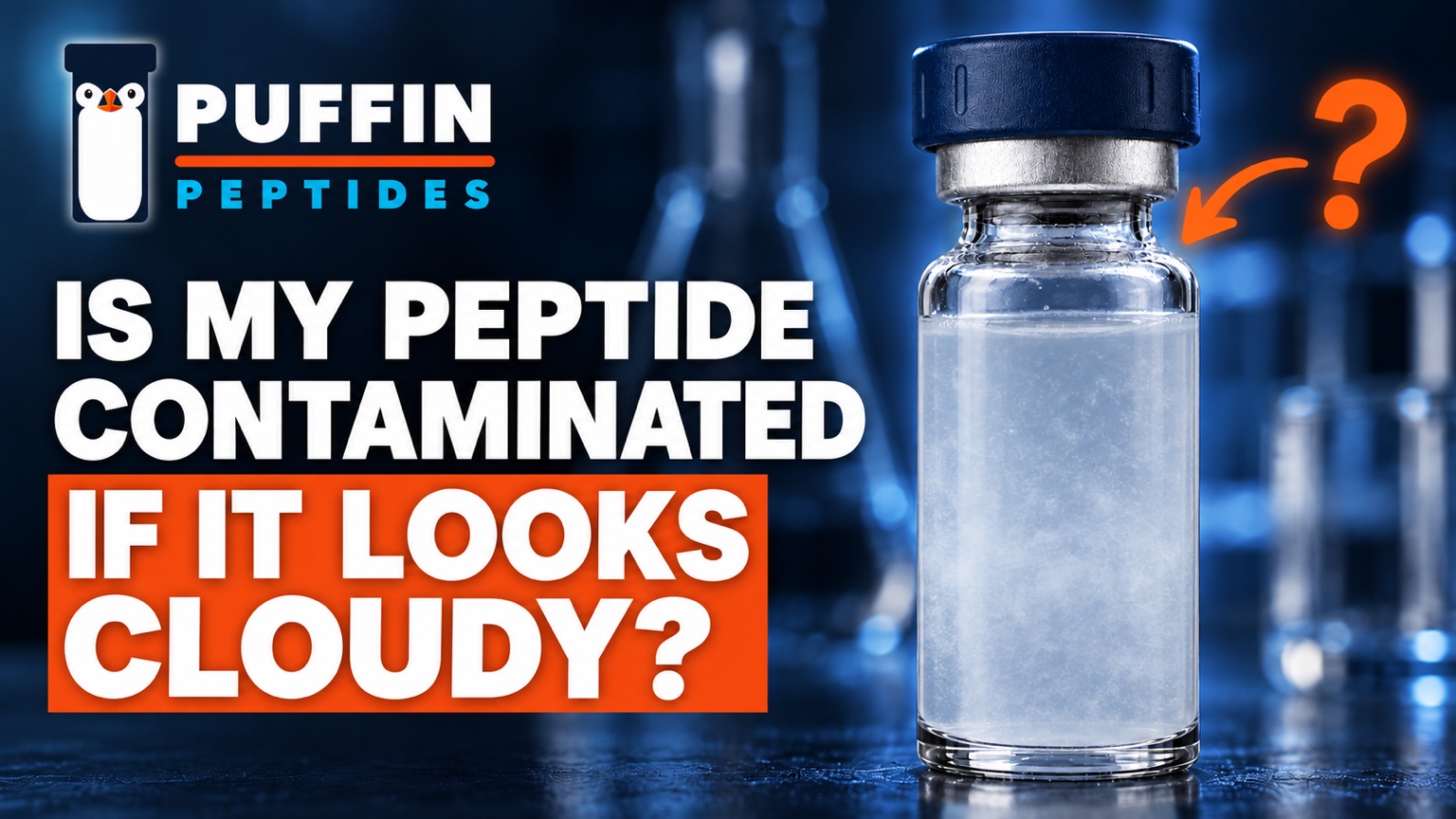
At A Glance
- Cloudiness can be a warning sign, but it does not reveal the cause by itself.
- Bubbles, crystals, fibres, flakes, colour changes, and damaged seals are different observations worth recording.
- A clear-looking vial can still have problems that only appropriate testing can detect.
- Set the vial aside, keep its packaging, photograph it, record the lot, and contact the supplier.
Does Cloudiness Mean My Peptide Is Contaminated?
Possibly, but a photograph or visual check cannot confirm contamination. Cloudiness and visible particles are warning signs because they show that the material does not have the expected appearance. Possible causes include foreign matter, microbial growth, precipitation, aggregation, incompatibility, temperature exposure, or container damage.
The reliable conclusion is narrower: an unexpected appearance means the vial should be isolated and investigated. It does not justify guessing the cause, and a later change in appearance does not prove that the material is acceptable.
What Should I Look For In The Vial?
Inspect the vial and packaging in good light. Compare the appearance with the written specification for that exact material and lot. Appearance is product-specific, and some legitimate pharmaceutical products are described as opalescent rather than perfectly transparent.
Record observations without trying to diagnose them. Note whether the concern appeared before or after opening, whether material floats or settles, whether colour changed, and whether the stopper, crimp, glass, label, or seal looks damaged.
- Unexpected haze, clouding, fibres, flakes, specks, crystals, film, or colour change
- Cracked glass, leakage, a loose crimp, a displaced stopper, or a missing seal
- The product, strength, lot number, date received, storage history, and date first noticed
- Clear photographs against light and dark backgrounds without opening or altering the vial
Are Bubbles, Crystals, And Particles The Same Thing?
No. Bubbles are gas and often move toward the surface, while particles are solid or semi-solid material. A still photograph may not distinguish them, and very small particles may be invisible. Visual inspection is therefore a screening step, not a laboratory identification method.
A freeze-dried cake can also vary in shape. Shrinkage, cracking, or collapse can reflect formulation or process conditions, but appearance alone cannot establish identity, purity, content, stability, or sterility.
What Can Actually Tell Me What Went Wrong?
Looking at the vial is useful, but it is only the first check. Different tests answer different questions, and a normal appearance is not the same as a fully verified vial.
| Study or context | What was explored | What it tells us | Useful context |
|---|---|---|---|
| Visual inspection | Checks appearance, visible particles, colour, and obvious container defects | Can identify a concern that needs investigation | Cannot identify the substance, detect every contaminant, or prove sterility |
| Container check | Examines the vial, stopper, crimp, seal, and evidence of leakage | Can reveal obvious damage or loss of integrity | Visual inspection alone is not a validated container-closure integrity test |
| Analytical testing | Uses named methods for identity, purity, content, sterility, endotoxin, or particles | Can answer the particular question covered by the method | One test result does not establish every other quality attribute |
What Should I Do If My Vial Looks Wrong?
Quarantine it from acceptable inventory and do not continue using the material. Keep the vial, box, label, and shipping materials together. Photograph the concern, record the lot number and timeline, and contact the supplier with those details.
A useful investigation should connect the complaint to the exact lot, review related reports, explain which specifications apply, and document the resolution. If a container is leaking or broken, avoid direct contact and follow suitable hazardous-material procedures for the substance involved.
If The Vial Is Clear, Does That Mean It Is Fine?
No. Microorganisms, endotoxins, incorrect compounds, and many chemical impurities may not be visible. A clear appearance only means that an obvious visual defect was not seen under the conditions of inspection.
A fuller quality record separates identity, purity, content, sterility, endotoxin, and particulate results. The companion guides in this library explain how to read those tests and their limits.
Common Questions About Cloudy Peptide Questions
Is cloudiness proof that a peptide vial is contaminated?+
No. It is a warning sign that requires quarantine and investigation, but appearance alone cannot identify the cause or confirm microbial contamination.
Can a clear peptide solution still be contaminated?+
Yes. A clear appearance does not rule out microorganisms, endotoxins, an incorrect compound, or chemical impurities that are not visible.
Should I filter or heat a cloudy peptide solution?+
No. Trying to make suspicious material look clear can alter the sample, introduce contamination, or hide evidence needed to investigate the lot.
What information should I send the supplier?+
Send clear photos, the product and lot number, the date received, storage history, when the change appeared, and any visible damage to the vial or seal.
Sources
Want to go a little deeper? These links take you to the studies and official records behind the guide. Study registries describe the plan; published papers report the findings.
- Visual Inspection of Injectable Products: Guidance for IndustryU.S. Food and Drug Administration · 2024
Explains visible-particle and container-defect inspection, investigations, and the limits of visual inspection.
- Routine Practices and Additional Precautions for Preventing Infection TransmissionPublic Health Agency of Canada · 2017
Advises inspection of multi-dose vials for clouding and particulate contamination and disposal when integrity is compromised.
- Q6A Specifications: Test Procedures and Acceptance CriteriaU.S. Food and Drug Administration · 2000
Treats appearance, identity, assay, impurities, sterility, endotoxins, and particulate matter as separate specification attributes.
- Annex 1: Manufacture of Sterile DrugsHealth Canada · 2024
Separates microbial, endotoxin or pyrogen, particle, and container-integrity controls in sterile-drug manufacturing.