
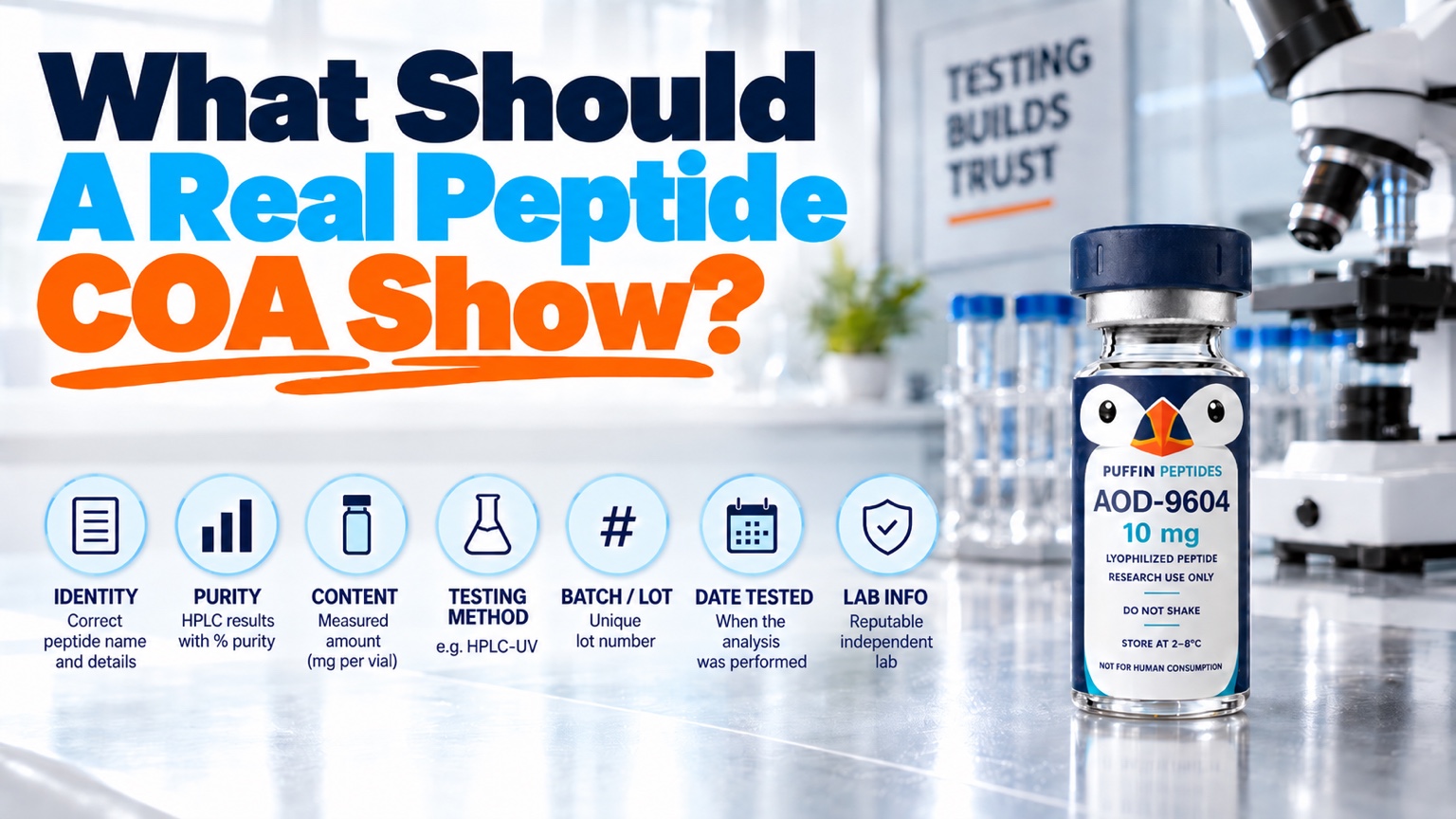
At A Glance
- The product, strength, and lot number should match your vial exactly.
- The report should identify the laboratory and show what was tested, how it was tested, and the actual result.
- A purity percentage does not automatically prove identity, vial content, sterility, or endotoxin level.
- A report you can verify with the laboratory is stronger than an image that only looks official.
What Is A COA And Why Should I Care?
A certificate of analysis, or COA, records tests performed on a batch or sample and the results obtained. In a formal quality system, it identifies the material and batch, lists specifications and numerical results, and is dated and authorized by the responsible quality unit or laboratory.
A COA is not a universal seal of approval. Read it as a set of answered questions: which sample was tested, by whom, using what method, against what limit, and with what result? Anything not listed remains unanswered by that certificate.
How Do I Know The COA Belongs To My Vial?
Start with the product name, strength or fill claim, and lot number. Those details should agree across the vial, product page, and report. The laboratory's sample identifier should also be traceable to the supplier's lot rather than appearing as an unexplained number.
Confirm the test and report dates, laboratory identity, sample description, methods, results, units, and acceptance limits. If the laboratory offers report verification, use the laboratory's own website rather than trusting only an image or QR code printed on the report.
- Exact product, form, strength or fill claim, and lot number
- Laboratory identity, report number, dates, and direct verification path
- Named methods, acceptance limits, numerical results, and units
- Who submitted the sample and whether collection was independent or witnessed
Does Third-Party Testing Cover Every Vial?
It establishes the reported results for the tested sample, assuming the report is authentic and the sample identity is reliable. Extending that result to every vial depends on representative sampling, batch uniformity, manufacturing controls, packaging, storage, and traceability.
A supplier-submitted sample is useful evidence, but it is different from an independently collected sample. The COA should not imply stronger chain-of-custody assurance than the actual sampling process supports.
What Do The Lines On A COA Actually Mean?
Every result answers one particular question. Read each line separately so a large purity number does not get mistaken for proof of everything else.
| Study or context | What was explored | What it tells us | Useful context |
|---|---|---|---|
| Identity | Mass spectrometry, NMR, or another suitably specific identification method | Supports that the tested sample contains the expected molecular identity | Does not establish amount, sterility, or endotoxin level |
| HPLC purity | Separates and measures detected chromatographic components | Estimates relative chromatographic purity under the stated conditions | Is not automatically peptide mass per vial and does not cover every possible impurity |
| Content or assay | Quantifies target material using a suitable method and reference | Addresses how much target material the tested sample contains | Depends on method, reference standard, units, and sampling |
| Sterility or endotoxin | Uses dedicated microbiological or bacterial-endotoxin methods | Answers the specific microbiological question named on the report | Cannot be inferred from HPLC purity, identity, or appearance |
How Can I Spot A Questionable COA?
Be cautious when a certificate has no matching lot, report number, laboratory contact information, method, unit, acceptance limit, or full result. A generic report reused across multiple strengths or lots cannot establish batch-specific results.
Other warning signs include impossible timelines, broken verification links, mismatched sample descriptions, altered logos, and claims such as “tested for everything” when only one or two methods are listed. Good documentation makes its limits easy to see.
What Else Should A Trustworthy Seller Provide?
A fuller quality record may include sampling details, specifications, chromatograms or raw data, reference standards, stability information, storage conditions, complaint handling, and change control. The exact record depends on the material and intended research.
The practical rule is simple: verify the report, match the lot, read every test separately, and never treat an untested attribute as a passing result.
Common Questions About Peptide COA Questions
Does 99 percent HPLC purity mean the vial contains the labelled amount?+
Not necessarily. Chromatographic purity and quantitative content are different measurements. A suitable content or assay result is needed to address amount.
Does a peptide COA prove sterility?+
Only when a suitable sterility test is explicitly listed and the report can be matched reliably to the lot. Identity or HPLC purity cannot substitute for sterility testing.
Can one COA cover multiple peptide lots?+
A batch-specific COA should identify the exact lot tested. A report for another lot may describe historical quality, but it does not establish the result for the current lot.
How can I verify a laboratory report?+
Use the laboratory's own verification page or contact details, confirm the report number, and compare the laboratory record with the complete certificate and the lot on the vial.
Sources
Want to go a little deeper? These links take you to the studies and official records behind the guide. Study registries describe the plan; published papers report the findings.
- Q7A Good Manufacturing Practice Guidance for Active Pharmaceutical IngredientsU.S. Food and Drug Administration · 2001
Describes COA content, batch identification, tests, limits, results, laboratory information, and supplier-verification expectations.
- IND Applications: Chemistry, Manufacturing, and Control InformationU.S. Food and Drug Administration · 2026
Distinguishes identity and purity methods and separately identifies sterility, endotoxin, and particulate information for injectable products.
- Q6A Specifications: Test Procedures and Acceptance CriteriaU.S. Food and Drug Administration · 2000
Treats appearance, identity, assay, impurities, sterility, endotoxins, and particulate matter as separate specification attributes.