
At A Glance
- KLOW combines GHK-Cu, BPC-157, TB-500, and KPV. The blend brings together research themes around tissue remodelling, cell movement, and inflammatory signalling.
- The ingredients have been explored in different tissue, cell, and animal models.
- Comparing individual ingredients and combinations helps reveal what contributes to a result.
What Is KLOW?
KLOW combines GHK-Cu, BPC-157, TB-500, and KPV. The blend brings together research themes around tissue remodelling, cell movement, and inflammatory signalling.
GHK-Cu adds the copper-peptide angle, BPC-157 the tissue-response background, TB-500 the thymosin-related connection, and KPV the inflammatory-response focus. That ingredient map is the clearest way to understand the name.
Why Does KLOW Appear In Several Different Conversations?
The four components come from overlapping but distinct areas. Skin, gut, and tissue-response research can share biological processes, which explains the broad interest. The linked papers let you explore those individual connections in more depth.
How Does KLOW Compare With Glow And Wolverine?
Wolverine pairs BPC-157 and TB-500. Glow adds GHK-Cu, and KLOW adds KPV as well. These are different ingredient combinations, not a simple ladder of strength. Component research explains the rationale; direct blend studies would be needed to establish combined outcomes.
A Closer Look At KLOW
Here are the key observations and the context that helps explain them. The original sources are linked below if you would like to explore further.
| Study or context | What was explored | What it tells us | Useful context |
|---|---|---|---|
| Component literature | Four separate research backgrounds | The ingredients have been explored in different tissue, cell, and animal models. | Those studies are not direct tests of KLOW. |
| Combination question | Understanding interactions | Comparing individual ingredients and combinations helps reveal what contributes to a result. | A blend name does not establish synergy or a combined clinical benefit. |
Common Questions About KLOW (GHK-Cu + BPC-157 + TB-500 + KPV)
What is KLOW?+
KLOW combines GHK-Cu, BPC-157, TB-500, and KPV. The blend brings together research themes around tissue remodelling, cell movement, and inflammatory signalling.
Why does KLOW appear in several different conversations?+
The four components come from overlapping but distinct areas. Skin, gut, and tissue-response research can share biological processes, which explains the broad interest. The linked papers let you explore those individual connections in more depth.
How does KLOW compare with Glow and Wolverine?+
Wolverine pairs BPC-157 and TB-500. Glow adds GHK-Cu, and KLOW adds KPV as well. These are different ingredient combinations, not a simple ladder of strength. Component research explains the rationale; direct blend studies would be needed to establish combined outcomes.
Sources
Want to go a little deeper? These links take you to the studies and official records behind the guide. Study registries describe the plan; published papers report the findings.
- The promoting effect of pentadecapeptide BPC 157 on tendon healing involves tendon outgrowth, cell survival, and cell migrationJournal of Applied Physiology · 2011
Component-level preclinical evidence only; the study did not test KLOW.
- PepT1-mediated tripeptide KPV uptake reduces intestinal inflammationGastroenterology · 2008
Component-level KPV research; the result cannot be assigned to the four-component blend.
- Stimulation of collagen synthesis in fibroblast cultures by the tripeptide-copper complex glycyl-L-histidyl-L-lysine-Cu2+FEBS Letters · 1988
Component-level GHK-Cu cell research; it does not establish a combined effect.
- Think twice before injecting peptides bought online: unauthorized products can seriously harm youHealth Canada · 2026
For KLOW (GHK-Cu + BPC-157 + TB-500 + KPV) context, this official Canadian advisory explains why a research-use label does not establish authorization, safety, efficacy, or product quality for human use.
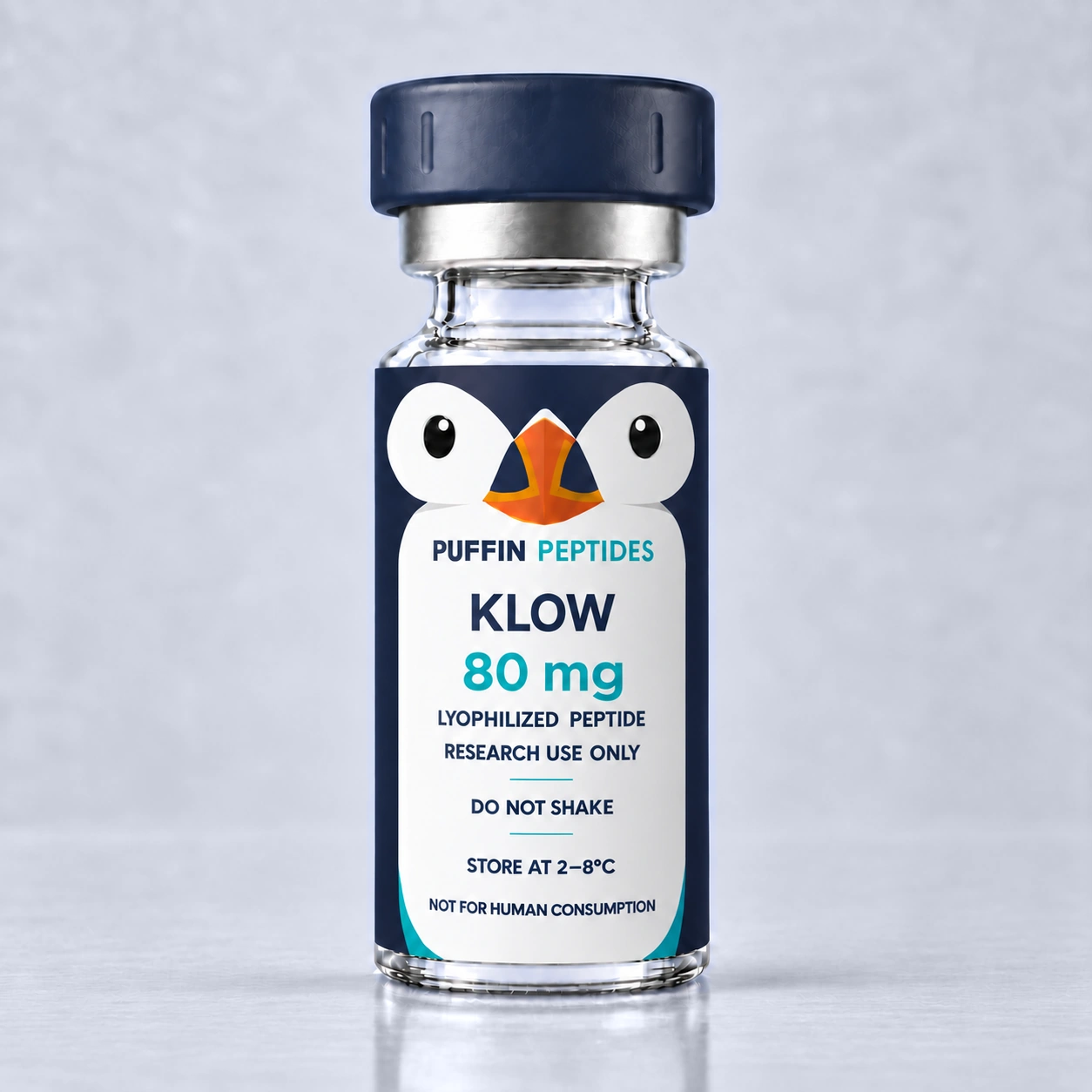
Explore KLOW
Review available strengths, pricing, stock status, and product documentation.