Skip to content
Every Peptide Explained & Sourced
Longevity Research

GHK-CU

5.0ReviewsRead more

Where regeneration meets radiance, GHK-Cu is a copper-binding peptide known for supporting skin renewal, collagen production, hair health, and tissue repair. Often featured in advanced aesthetic and wellness formulas, it is designed to help promote firmer-looking skin, stronger hair, and a more youthful, revitalized appearance.

Batch details included Manufactured in Canada
$45 CADCAD · shipping and taxes shown at checkout

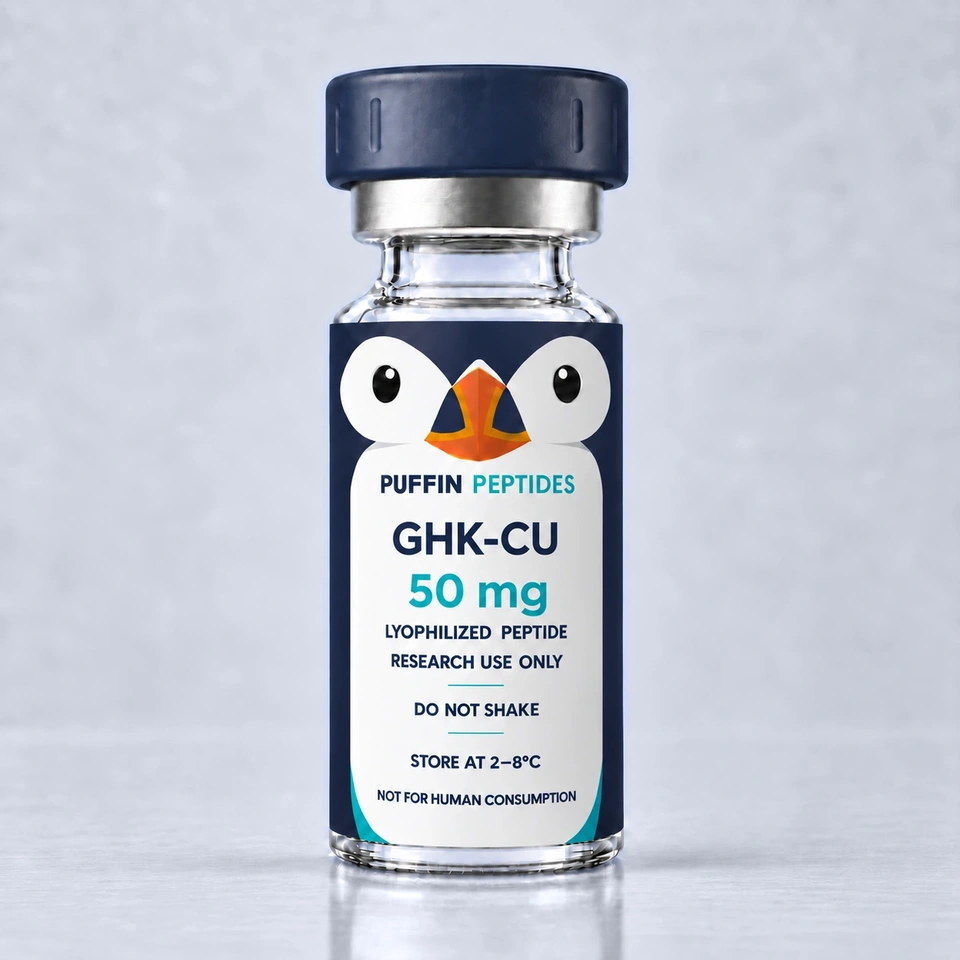
GHK-CU is supplied as 50 mg of lyophilized powder in a sealed glass vial for laboratory research. Confirm the selected vial and batch details before preparation.

Selected strength50 mg
Purity99.36%
TestingHPLC-UV
BatchPP-LOT-015
+ Show Scientific Details− Hide Scientific Details
Compound classCopper-binding tripeptide complex
Parent peptideGly-His-Lys (GHK)
Peptide length3 amino acids
SequenceGHK
Research themesCopper-peptide biology · Fibroblasts · Extracellular matrix
Scientific profile

GHK-Cu is a copper complex of the naturally occurring tripeptide glycyl-L-histidyl-L-lysine. Published databases contain more than one stoichiometric representation of the copper complex, so salt/complex-specific formula and molecular weight are not displayed.

Product guide

GHK-CU Explained

A clear, quick look at what GHK-CU is, how it works, and why it is being studied.

What is GHK-Cu supposed to help with?

GHK-Cu is the copper peptide people usually mean when talking about skin renewal, collagen, firmness, and healthy aging. Its appeal is helping skin look better by supporting the tissue underneath it.

Research Context

GHK is a naturally occurring tripeptide with high affinity for copper; GHK-Cu has been studied in fibroblast activity, collagen synthesis, extracellular-matrix remodelling and wound biology. Clinical evidence varies substantially by formulation and outcome. [1–2]

What does collagen actually do for skin?

Collagen is like the support frame under a mattress. When that frame is strong, skin looks firmer and smoother; when it weakens, fine lines and looseness become easier to see.

Research Context

Collagen is a major structural protein in the dermal extracellular matrix and contributes to tensile strength and tissue architecture. GHK-Cu research includes effects on fibroblast activity and matrix-remodelling pathways. [1–2]

Can GHK-Cu help skin look smoother?

That is one of the main reasons it is studied. Its connection to collagen and tissue renewal creates interest in improving the look of texture, firmness, and fine lines over time.

Research Context

Mechanistic and cosmetic literature supports interest in firmness, elasticity and photoaged skin, but modern large randomized trials are limited. The strongest evidence concerns fibroblasts, collagen and matrix remodelling rather than a guaranteed cosmetic result. [1–2]

Is GHK-Cu only about appearance?

No. Skin gets the spotlight, but GHK-Cu is also connected to wound repair and wider tissue-renewal research. The same repair biology that interests skincare researchers can matter elsewhere too.

Research Context

No. GHK-Cu research extends to wound repair, angiogenesis, inflammation and extracellular-matrix remodelling. Skin appearance is one application of broader tissue-remodelling biology. [1–2]

Why is copper attached to the peptide?

The peptide acts like a delivery partner that binds copper and helps bring it into cellular repair processes. Think of the peptide as carrying an important tool to the repair crew.

Research Context

GHK binds Cu2+ with high affinity, forming a defined complex involved in copper-dependent biological processes. Copper is a cofactor for multiple enzymes relevant to connective-tissue biology. [1–2]

Is GHK-Cu the same as a regular copper supplement?

No. A mineral supplement provides dietary copper. GHK-Cu is a specific copper-bound peptide studied for how it communicates with cells involved in collagen and repair.

Research Context

No. Dietary copper changes systemic copper intake, while GHK-Cu is a defined copper-peptide complex studied for specific signalling and tissue-remodelling effects. [1–2]

How is GHK-Cu different from AHK-Cu?

GHK-Cu is the better-known choice for skin, collagen, and broad tissue renewal. AHK-Cu has a more specific reputation in hair-follicle research.

Research Context

Both are copper-binding tripeptides, but their amino-acid sequences differ. AHK-Cu has a smaller literature with notable hair-follicle/dermal-papilla work, while GHK-Cu has broader published research around collagen, fibroblasts and tissue remodelling. [1–2]

Why choose GHK-Cu instead of Glow or KLOW?

GHK-Cu keeps the focus on the copper-peptide side. Glow and KLOW include it inside larger blends for people who also want recovery or inflammation-focused ingredients.

Research Context

GHK-Cu isolates the copper-peptide variable; Glow and KLOW combine it with additional research compounds. Evidence for GHK-Cu itself should not be treated as validation of every multi-compound blend containing it. [1–2]

Read the full GHK-CU evidence guideStudy design, primary sources, limitations, and unanswered questions.Open guide
Research-use statement

This product is offered for laboratory research only. It is not for human consumption and is not represented as a medicine, treatment, supplement or substitute for an approved product.

Preparation guide

Calculate. Prepare. Store.

Confirm the selected vial and BAC-water amount, enter the target amount, then follow the preparation and storage steps.

Step 1: Calculate

The selected strength automatically opens with the easy starting rule of 1 mg = 10 units.

GHK-CU · 50 mg selected

Vial Strength
50mg

Easy rule: 1 mg = 10 units · Every 10 units = 1 mg

Calculated result
U-100 syringe20 units2 mg at the current water amount

This calculator converts the values entered. It does not choose an amount.

Step 2: Prepare

This 50 mg vial opens with 5 mL of BAC water, creating the easy starting rule of 1 mg = 10 units.

If the water amount is changed above, use the updated easy rule shown by the calculator.

Do not shake the vialSlowly add the water down the inside wall of the vial, then gently swirl until fully dissolved.

Step 3: Store

Prepared vialsRefrigerate at 2–8°C

Unprepared vialsKeep cool and dry, away from heat, moisture, and direct sunlight

Shipping & delivery

Picked And Shipped Within 24 Hours.

Every order is prepared and packed in Canada with care, accuracy, and attention to detail. In-stock orders are checked and packed within 24 hours, then shipped with Canada Post. Tracking is sent after the parcel’s first carrier scan.

Bilingual Shipped by Canada Post logo with English to the left and French to the right

Customer Reviews

5.0★★★★★

2 customer reviews

Share your experience

Reviews are checked before publication. Your email is never displayed.

2 reviewsShowing 2
Lacey HughesVerified buyer
★★★★★
Puffin Peptides

Nice site and helpful chat bot. I’ll be back again.

Kimmy SonnVerified buyer
★★★★★
Puffin Peptides

I can’t believe it but I’ve lost 30lb. It’s been 3 months and felt compelled to write a review. I know it’s not Puffin I have to thank but their site came up in google and brought me here. Thank youuuuuu! <3

Reviews

There are no reviews yet.

Only logged in customers who have purchased this product may leave a review.

Product documentation

Batch Details

Uploaded documents50 mg
PDF · 50 mgPP-GHK-CU-50-MG-R015.pdfPublished for GHK-CU 50 mg
View document
ProductGHK-CU
Strength50 mg
Catalogue codePP-GHK-CU-50-MG
PresentationLyophilized powder in a sealed glass vial
StorageSee vial label and lot-specific documentation
Intended useLaboratory research only · not for human consumption

Only uploaded documents published for the selected vial strength are shown here.

Search the catalogue

What Are You Looking For?