
At A Glance
- A high HPLC purity number is not an all-purpose safety score.
- Identity, purity, and the amount of peptide in a vial are three different questions.
- Sterility and endotoxin results require their own tests.
- A report only supports the tests actually listed for the matching sample and lot.
What Does 99 Percent Purity Actually Mean?
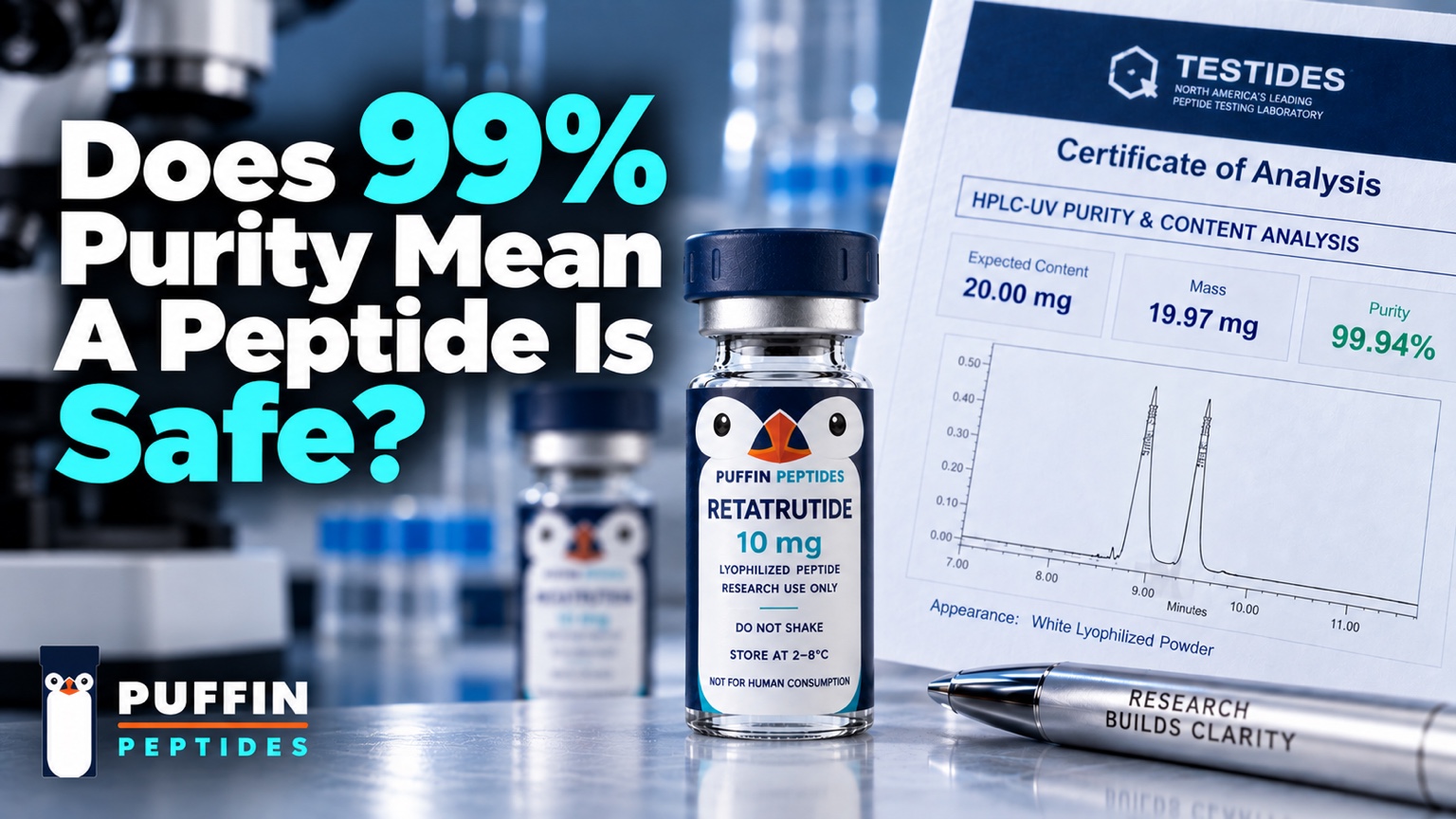
On an HPLC report, 99 percent purity usually describes the share of the measured chromatographic signal assigned to the main component under that method's conditions. It does not mean that 99 percent of everything inside the vial is active peptide by weight.
The result applies to the tested sample and the named method. It does not automatically establish molecular identity, fill amount, sterility, bacterial endotoxin level, absence of visible or subvisible particles, or stability through a claimed storage period.
Is Purity The Same As The Amount In The Vial?
Identity testing asks whether the expected molecule is present and may use mass spectrometry, NMR, or another suitably specific method. Purity testing separates detected components and estimates how much of the measured signal belongs to the target component under the method used.
Content or assay testing asks how much target material is present. A sample can show high relative chromatographic purity while containing less total peptide than a vial label claims because purity percentage and total quantity are different measurements.
If It Passes Sterility, Does That Mean It Has No Endotoxin?
No. Sterility testing looks for viable contaminating microorganisms under defined test conditions. Bacterial endotoxin testing looks for endotoxins associated with certain bacteria. A sample can pass one test and fail the other.
Endotoxin testing also does not cover every possible pyrogen, chemical impurity, or microorganism. Formal specifications list sterility and endotoxins separately rather than treating either as a substitute for the other.
Which Test Answers Which Customer Question?
Use this table when reading a report. If a test is missing, another result cannot be used as a substitute for it.
| Study or context | What was explored | What it tells us | Useful context |
|---|---|---|---|
| Identity | Is the expected molecule present? | A specific identity result for the tested sample | Does not establish amount, sterility, or endotoxin level |
| Purity | What proportion of measured signal fits the target component? | Relative purity under the named analytical conditions | Does not equal milligrams per vial or detect every possible impurity |
| Content or assay | How much target material is present? | A quantity tied to the method, reference, and units | Does not establish sterility or stability |
| Sterility | Are viable microorganisms detected under the test conditions? | A result from the named sterility method | Sampling and method limits apply, and the test does not measure endotoxin |
| Endotoxin | Is bacterial endotoxin below the stated limit? | A result compared with a stated limit | Does not establish sterility or absence of every pyrogen |
| Particulate matter | Are visible or subvisible particles within specification? | A result for the particle range and method tested | Clear appearance cannot replace subvisible-particle testing |
What Testing Information Should I Look For?
The appropriate panel depends on the material, formulation, research protocol, and risk assessment. Every public result should identify the exact lot, sample description, method, acceptance limit, numerical result and units where applicable, test date, report date, and laboratory.
For material represented as sterile or intended for parenteral research, chemical purity alone is not a complete quality specification. Official guidance treats sterility, endotoxins, and particulate matter as separate attributes requiring their own procedures and limits.
Can I Compare Purity Numbers From Different Reports?
Compare like with like: the same method, reporting basis, units, specification, and sample type. A percentage from one HPLC method may not be directly comparable with a percentage from another, and “below detection” depends on the method's detection capability.
The strongest summary is specific rather than promotional. Name what passed, the limit it passed, the lot tested, and what remains outside the report's scope.
Common Questions About Peptide Purity And Safety Questions
Is peptide purity the same as peptide content?+
No. Purity describes the relative analytical signal attributed to the target component. Content or assay measures how much target material is present.
Does HPLC purity prove a peptide is sterile?+
No. Sterility requires a dedicated microbiological test and cannot be inferred from chromatographic purity.
Can a sterile sample contain endotoxin?+
Yes. Sterility and bacterial endotoxin are separate attributes, so a sample can meet one specification without meeting the other.
Does a clear vial pass particulate testing?+
Not necessarily. Visual inspection can detect some visible particles, while subvisible particles require an appropriate instrumental test.
Sources
Want to go a little deeper? These links take you to the studies and official records behind the guide. Study registries describe the plan; published papers report the findings.
- Q6A Specifications: Test Procedures and Acceptance CriteriaU.S. Food and Drug Administration · 2000
Treats appearance, identity, assay, impurities, sterility, endotoxins, and particulate matter as separate specification attributes.
- IND Applications: Chemistry, Manufacturing, and Control InformationU.S. Food and Drug Administration · 2026
Distinguishes identity and purity methods and separately identifies sterility, endotoxin, and particulate information for injectable products.
- Annex 1: Manufacture of Sterile DrugsHealth Canada · 2024
Separates microbial, endotoxin or pyrogen, particle, and container-integrity controls in sterile-drug manufacturing.
- Guidelines on the Endotoxins TestUnited States Pharmacopeia · 2024
Describes bacterial endotoxin testing, including limits, interference, standards, and routine testing controls.